Rapamycin · dogs
Rapamycin for dogs: what the science says
Dogs may be the clearest early signal of whether rapamycin slows mammalian ageing outside the lab. Here is where the evidence stands.
Dogs are a compelling test case for longevity science. They share our homes, our environment and many of our age-related diseases; they vary enormously in size, shape and genetics; and they age faster than we do — so a real anti-ageing effect should show up sooner.[1] That is why rapamycin research in dogs draws so much attention, and why the dog result may arrive before the human one.
Why the dog model is unusually good
Most ageing research happens in laboratory mice: genetically uniform animals, in identical cages, eating identical food. That control is a strength for mechanism and a weakness for prediction — it strips out exactly the environmental variation that makes real ageing messy.
Companion dogs invert that trade-off. They live in the human environment with all its noise, they get spontaneous age-related disease rather than engineered disease, and their body sizes span a tenfold range with a well-known inverse relationship between size and lifespan. A drug effect that survives that much heterogeneity is a far better bet to translate.[1]
What early dog studies found
Small studies using non-immunosuppressive, intermittent dosing (on the order of a few times weekly for a number of weeks) reported improvements in echocardiographic measures of heart function, without major adverse effects at those doses.[5] These were short and small — pilot-scale work, with the limits that implies — but encouraging enough to justify a much larger trial.
Promising pilots · definitive trial still runningTRIAD: what is actually being tested
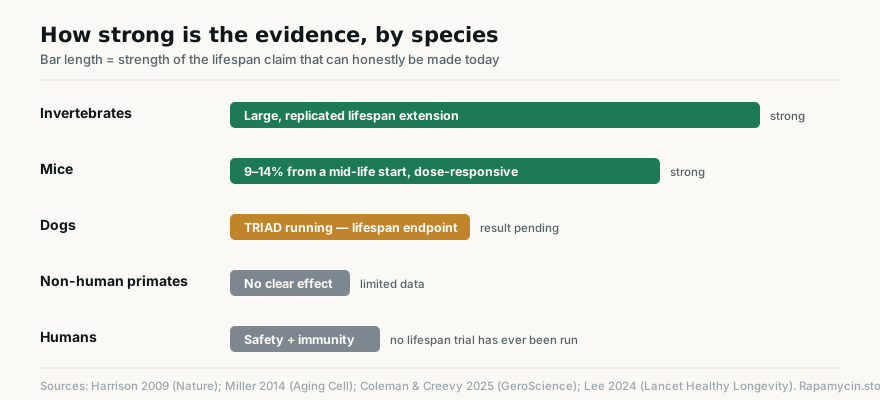
The Test of Rapamycin in Aging Dogs is a prospective, parallel-group, double-masked, randomised, placebo-controlled, multicentre trial of rapamycin in healthy middle-aged dogs recruited from Dog Aging Project participants.[1] The design paper is explicit about its own significance: this is the first rigorous test of a pharmacologic intervention against biological ageing, with lifespan and healthspan metrics as endpoints, performed outside of the laboratory in any species.
| Design feature | TRIAD | Why it matters |
|---|---|---|
| Masking | Double-masked | Neither owners nor veterinarians know who got the drug — owner-reported outcomes are otherwise wide open to expectation. |
| Control | Placebo-controlled | Ageing outcomes drift for many reasons; without a placebo arm you are measuring the drift. |
| Sites | Multicentre | Results are not an artefact of one clinic's population or practice style. |
| Population | Healthy, middle-aged | Tests rapamycin as prevention, matching the mouse experiments that started treatment in mid-life.[3] |
| Endpoints | Lifespan + healthspan metrics | Hard endpoints, not biomarkers — the thing no human rapamycin trial has yet delivered. |
Enrolment numbers, dose schedules and eligibility criteria are published and updated by the Dog Aging Project consortium.[2]
That last row is the reason to care. Every completed human rapamycin trial has measured safety, immune function or biomarkers. TRIAD is measuring how long the animals live and how well they function while doing it — in a species that shares your house.
What a positive result would and would not mean
If TRIAD shows a lifespan or healthspan benefit, it would be the strongest cross-species evidence for rapamycin short of a human trial, and it would meaningfully raise the prior for the human question. It would not establish a human dose, a human schedule, or a human safety profile — dogs metabolise the drug differently, live differently and die of different things in different proportions.
If TRIAD is null, that would be a substantial blow to the translation case, and worth far more attention than another positive mouse study. Either way, this is the readout to watch.
Safety and the honest caveat
Rapamycin is a potent immunosuppressant.[4] The dog longevity approach relies on low intermittent dosing precisely to avoid heavy immune suppression, but the right dose, schedule and long-term safety in dogs are still being established under controlled conditions.[1] Mild gastrointestinal upset is the effect most commonly reported at these doses; infection risk and wound healing are the theoretical concerns that veterinary monitoring exists to catch.
This is not something to source and administer yourself. Human tablets are not a dosing guide for a 6 kg or a 60 kg dog, an ongoing trial is not a green light, and a dog cannot tell you it feels unwell. If you are interested, talk to your veterinarian and look into legitimate study participation.
If you want to take part
- Start with the Dog Aging Project itself — TRIAD recruits from within its existing participant cohort, so enrolling your dog in the observational study is the entry path.[2]
- Talk to your own veterinarian first, especially if your dog has existing heart, kidney or immune conditions.
- Be realistic about the commitment: hard-endpoint trials are long by construction.
For the human side of the same drug, see the rapamycin evidence guide, rapamycin side effects, and our page on the Dog Aging Project.
Frequently asked questions
Is rapamycin safe for dogs?
Low, intermittent dosing has been used in dog studies without major reported problems, and TRIAD's design was reviewed and approved by institutional animal care committees. But rapamycin is a serious immunosuppressant and longevity dosing for dogs is still under study. It should only be given under veterinary supervision, never self-administered.
What is the Dog Aging Project testing?
The Dog Aging Project's TRIAD trial is a double-masked, placebo-controlled, multicentre study of rapamycin in healthy middle-aged companion dogs, with lifespan and healthspan metrics as endpoints. It is the first rigorous test of a drug against biological ageing with those endpoints run outside a laboratory in any species.
Can I give my dog rapamycin for longevity?
Not on your own. This is an experimental, prescription intervention. If you are interested, the appropriate step is a conversation with your veterinarian, and where possible enrolment in a legitimate study rather than off-label self-dosing.
Why are dogs used to study ageing?
Companion dogs share our homes, environment and many age-related diseases, vary enormously in size and genetics, and age faster than we do. That combination means a real anti-ageing effect should appear on a much shorter timeline than a human trial would need.
How old does a dog have to be for the TRIAD trial?
TRIAD recruits healthy middle-aged dogs from existing Dog Aging Project participants rather than dogs already in decline — the intervention is being tested as prevention, not as treatment. Current eligibility criteria, including age and weight bands, are published by the project itself and change over time.
Does rapamycin help dogs with heart problems?
Earlier small studies using non-immunosuppressive intermittent dosing reported improvements in echocardiographic measures of heart function in older dogs. Those studies were short and small; cardiac outcomes are among the endpoints TRIAD is powered to examine properly.
What are the side effects of rapamycin in dogs?
Mild gastrointestinal upset is the most commonly reported effect at low intermittent doses. Because rapamycin dampens immune signalling, infection risk and wound healing are the theoretical concerns that veterinary monitoring is designed to catch.
When will TRIAD results be available?
TRIAD is a long trial by design — it has to be, because lifespan is an endpoint. Interim and final readouts are published by the Dog Aging Project consortium, and the study-design paper is the right place to understand what will and will not be answered.
References
- Test of Rapamycin in Aging Dogs (TRIAD): study design and rationale. Coleman AE, Creevy KE et al. GeroScience 2025;47(3):2851–2877.Double-masked, placebo-controlled, multicentre; lifespan + healthspan endpoints in companion dogs.
- Rapamycin and the TRIAD trial in companion dogs. Dog Aging Project.
- Rapamycin fed late in life extends lifespan in genetically heterogeneous mice. Harrison DE et al. Nature 2009;460:392–395.9–14% mouse lifespan extension started mid-life.
- Rapamycin for longevity: the pros, the cons, and future perspectives. Roark KM, Iffland PH. Frontiers in Aging 2025;6:1628187.Peer-reviewed review, cited 31 times.
- Rapamycin — topic overview. FoundMyFitness.
Own a longevity or health brand?
Rapamycin.store publishes sponsored and guest posts on an aged, topically-relevant domain, and offers display advertising. Tell us what you want to promote and we'll send our current options.