Rapamycin · safety
Rapamycin side effects by dose and schedule
Rapamycin's side-effect profile is not one thing — it changes dramatically with how much you take and how often. Dose and schedule are the whole story.
Because the same drug behaves very differently at transplant doses versus a small weekly dose, it makes little sense to talk about "rapamycin side effects" without naming the schedule. Below we separate the two worlds. For the broader evidence picture, see the main rapamycin longevity guide.
The whole picture on one table
| Effect | Continuous immunosuppressive dosing | Low intermittent (weekly) dosing |
|---|---|---|
| Mouth ulcers (stomatitis) | The signature mTOR-inhibitor effect; common enough at oncology doses to be pooled and quantified across seven phase 3 trials[4] | The most commonly reported nuisance effect; usually manageable by adjusting dose or interval |
| Blood counts | Reduced cell counts documented across decades of transplant use[1] | Significant declines in haemoglobin, haematocrit and red-cell indices seen even at 1 mg daily over 8 weeks — without clinical events at that length[3] |
| Lipids | Raised cholesterol and triglycerides are well documented[1] | Biomarkers stayed within normal ranges across 48 weeks at 5–10 mg weekly[2] |
| Glucose / insulin | Insulin resistance; attributed largely to chronic mTORC2 disruption[1] | No adverse glucose signal in the published weekly-dosing data[2] |
| Infection risk | Increased — this is the intended pharmacology[1] | A phase 2a trial of brief TORC1 inhibition reported fewer infections over the following year (p = 0.001)[5] |
| Wound healing | Impaired — relevant before any surgery[1] | Not systematically studied; treat surgery as a reason to pause and ask |
| Reproductive | Effects on menstrual and ovarian function reported in some studies[1] | Unstudied. A reason not to use it while trying to conceive |
What happens at high, continuous doses
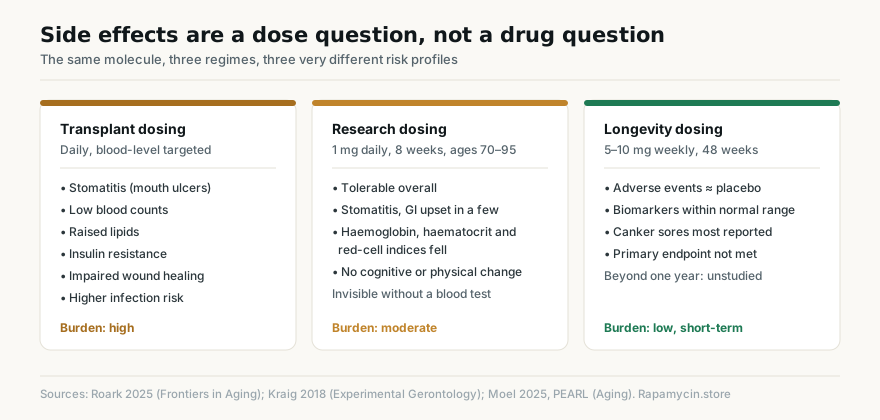
At the doses used to prevent transplant rejection, rapamycin is a serious immunosuppressant with a well-documented list of effects. Reported problems include mouth ulcers (stomatitis), reduced blood cell counts, raised cholesterol and triglycerides, insulin resistance, impaired wound healing and increased infection risk; some studies also report effects on menstrual and ovarian function in women.[1] These are not fringe observations — they come from decades of clinical use in transplant medicine, and they are the source of nearly every alarming sentence written about the drug.
Why stomatitis is the signature effect
Mouth ulcers are so characteristic of this drug class that they have been pooled and analysed across seven randomised phase 3 trials of everolimus, a rapamycin derivative, in solid tumours and tuberous sclerosis.[4] Oncology doses are far above anything used for longevity, so the incidence figures do not transfer — but the mechanism does. It is the reason canker sores are the thing weekly-dosing users most often report, and the reason a persistent ulcer is worth a clinical conversation rather than a stronger mouthwash.
How low intermittent dosing changes the picture
The off-label longevity approach deliberately uses low, intermittent (often weekly) dosing to nudge mTORC1 without the heavy, continuous immune suppression that drives the worst effects. The pharmacological basis is real: sirolimus has an elimination half-life on the order of 62 hours, so a weekly dose produces a peak and then a substantial trough rather than a maintained blood level.[6] The theory is that the trough is what protects mTORC2 — and mTORC2 disruption is the mechanism behind the metabolic effects.[1]
What human trials actually show
The longest longevity-specific data comes from the PEARL trial: 48 weeks of compounded rapamycin at 5 mg or 10 mg weekly in healthy adults. Adverse events and serious adverse events were similar across all groups including placebo, and blood biomarker changes stayed within normal ranges.[2] That is genuinely reassuring on short-to-medium-term tolerability.
Two caveats belong right next to it. "Tolerated for 48 weeks in a few hundred people" is not "proven safe for a decade," and PEARL's authors are employees and shareholders of the telehealth company that ran the trial — a declared conflict that belongs in your reading of a safety result.[2]
Tolerable short-term · long-term unknownThe counterintuitive immune finding
The most surprising thing in this literature is that brief, low-dose mTOR inhibition has been shown to improve immune function in older adults rather than degrade it. A phase 2a randomised trial in 264 elderly participants found that six weeks of low-dose TORC1-selective inhibition was associated with a significant reduction in reported infections over the following year, alongside upregulated antiviral gene expression and a better response to influenza vaccination.[5]
This does not mean rapamycin is immune-boosting in general. It means that the immune ageing being corrected in older adults and the immune suppression achieved in transplant patients are different pharmacological regimes of the same drug — separated by dose and duration. It is the single best illustration of why dose-free statements about this drug are worthless.
The effect you cannot feel
Kraig's trial of 1 mg daily in adults aged 70–95 is worth knowing precisely because its main finding was invisible. No cognitive, physical-performance or self-reported health measure changed over eight weeks. What did change, with statistical significance, were haemoglobin, haematocrit, red blood cell count, red cell distribution width, mean corpuscular volume and mean corpuscular haemoglobin.[3] None of it was clinically significant over that short window, and none of it would have been noticed without a blood test.
That is the argument for monitoring in one paragraph. Feeling fine is not evidence of nothing happening.
When to stop and call your prescriber
- Any sign of infection — fever, persistent cough, a wound that is not healing.
- Mouth ulcers that persist or worsen rather than settling between doses.
- Before any planned surgery or dental procedure, given the wound-healing effect.[1]
- Unusual fatigue or breathlessness — the symptoms a falling haemoglobin would eventually produce.[3]
- Starting any new medication, because of CYP3A4 interactions.[6]
The bottom line on risk
Rapamycin is not a benign supplement; it is a prescription immunosuppressant whose risk profile you can lower but not erase by dosing carefully. The published weekly-dosing data are reassuring as far as they go, and they do not go as far as the marketing does. The dose and schedule you would even consider are decisions for a clinician, which ties directly into the unsettled question of what dosage people use for longevity, and the practical question of what monitoring costs.
Frequently asked questions
What are the most common side effects of rapamycin?
At the higher continuous doses used for immune suppression, the most reported effects are mouth ulcers (stomatitis), raised cholesterol and triglycerides, low blood counts, insulin resistance, slower wound healing, and higher infection risk. Low intermittent longevity dosing aims to reduce these.
Does low-dose rapamycin have fewer side effects?
That is the intention behind intermittent low dosing, and early human data is reassuring on tolerability. The PEARL trial found adverse events at 5 mg and 10 mg weekly were similar to placebo across 48 weeks, with blood biomarkers staying within normal ranges — though that does not prove long-term safety or a lifespan benefit.
Does rapamycin weaken the immune system?
At transplant-level doses, yes — that is its intended job. At low intermittent doses the picture is more interesting: two randomised trials of brief mTOR inhibition in older adults found improved vaccine response and fewer infections, which is the opposite of blanket suppression. Whether that holds over years of dosing is unstudied.
Can rapamycin cause mouth ulcers?
Yes. Mouth ulcers, also called stomatitis or aphthous ulcers, are the single most characteristic side effect of mTOR inhibitors, and a pooled analysis of seven phase 3 everolimus trials confirms how common it is at oncology doses. It is strongly dose-related, and it is the effect people on weekly longevity dosing most often report.
Is rapamycin safe to take for longevity?
Its long-term safety for healthy people taking it to slow ageing is not established. It is a prescription immunosuppressant with real risks, so any use should be supervised by a licensed clinician, not self-directed.
How do you manage rapamycin mouth sores?
Dose reduction or a longer interval between doses is the lever that actually works, and that is a prescriber's decision. Alcohol-free mouthwash, avoiding abrasive or acidic foods around dosing, and good oral hygiene are the usual supportive measures. Persistent or severe ulcers warrant a clinical review rather than self-management.
Does rapamycin raise cholesterol?
Raised cholesterol and triglycerides are among the best-documented effects at continuous immunosuppressive dosing. At weekly longevity dosing the 48-week PEARL data reported blood biomarkers remaining within normal ranges — which is why lipids belong on the monitoring panel rather than being assumed either way.
Can rapamycin affect blood counts?
Yes, and this is the effect most often missed because it is invisible without a blood test. A trial of 1 mg daily in adults aged 70–95 found statistically significant declines in haemoglobin, haematocrit, red blood cell count and related indices over eight weeks — none clinically significant at that duration, but all detectable only on a complete blood count.
Does rapamycin interact with other drugs?
Yes. Sirolimus is metabolised by CYP3A4, so it interacts with a substantial list of medicines — including some antifungals, macrolide antibiotics and seizure medications — as well as grapefruit juice. Any prescriber needs your full medication list before writing for it.
How long do rapamycin side effects last?
Sirolimus has a long elimination half-life of roughly 62 hours, so effects tied to peak exposure fade over days rather than hours after a dose. Effects tied to sustained exposure, such as lipid changes, track the overall schedule instead.
References
- Rapamycin for longevity: the pros, the cons, and future perspectives. Roark KM, Iffland PH. Frontiers in Aging 2025;6:1628187.Peer-reviewed review, cited 31 times.
- Influence of rapamycin on safety and healthspan metrics after one year: PEARL trial results. Moel M et al. Aging (Albany NY) 2025;17(4):908–936.48-week RCT, 5/10 mg weekly; safe, no visceral-fat change; authors employed by AgelessRx — note conflict.
- A randomized control trial to establish the feasibility and safety of rapamycin treatment in an older human cohort. Kraig E et al. Experimental Gerontology 2018;105:53–69.n=25, aged 70–95, 1 mg daily 8 weeks; tolerable, but measurable red-cell index changes.
- Meta-analysis of stomatitis in clinical studies of everolimus: incidence and relationship with efficacy. Rugo HS et al. Annals of Oncology 2016;27(3):519–525.Pooled data from seven phase 3 trials — the best quantification of mTOR-inhibitor stomatitis.
- TORC1 inhibition enhances immune function and reduces infections in the elderly. Mannick JB et al. Science Translational Medicine 2018;10(449):eaaq1564.Phase 2a, n=264; significant reduction in reported infections over one year (p=0.001).
- Sirolimus. Wikipedia.
Own a longevity or health brand?
Rapamycin.store publishes sponsored and guest posts on an aged, topically-relevant domain, and offers display advertising. Tell us what you want to promote and we'll send our current options.