Rapamycin · skin
Topical rapamycin and rapamycin cream for skin
A compounded prescription cream with real dermatologic uses, one genuinely positive small trial, and a thinner anti-ageing evidence base than the marketing suggests.
Rapamycin's longevity story is mostly about pills, but a large share of consumer interest — and this domain's own history — centres on the cream. The logic is appealing: apply rapamycin to the skin and you inhibit mTOR in skin cells locally, potentially getting a cosmetic benefit without the systemic immune suppression that oral dosing can cause.[2]
What it is
Topical rapamycin is generally a compounded preparation: a pharmacy formulates rapamycin (sirolimus) into a cream, gel or ointment at a specified concentration on a clinician's prescription. Anti-ageing formulations are usually very dilute — commonly quoted in the 0.001%–0.01% range — because the target is local mTOR signalling in skin cells, not systemic exposure.
Because it is compounded rather than a mass-market cosmetic, the concentration, the vehicle it is dissolved in and the quality control all differ from pharmacy to pharmacy. Two products both described as "rapamycin cream" may deliver very different amounts of drug to the dermis.
The one trial worth knowing
The most-cited human evidence is an exploratory, prospective, randomised, placebo-controlled trial run in a clinical dermatology setting.[1] Participants were over 40, with visible photoageing and dermal volume loss, and applied topical rapamycin over an extended course before skin biopsies were taken.
| What was measured | Result | How to read it |
|---|---|---|
| p16INK4A (cellular senescence marker) | Significantly reduced (p = 0.008) | The headline finding — direct evidence of reduced senescent-cell burden in treated skin. |
| Collagen VII | Significantly increased (p = 0.008) | Collagen VII anchors the epidermis to the dermis; it declines with age. |
| Histology | Improved appearance of skin tissue | Assessed on biopsy, not by the participants. |
| Clinical appearance | Improvement noted in multiple participants | The softest endpoint — "noted in multiple participants" is not a quantified cosmetic outcome. |
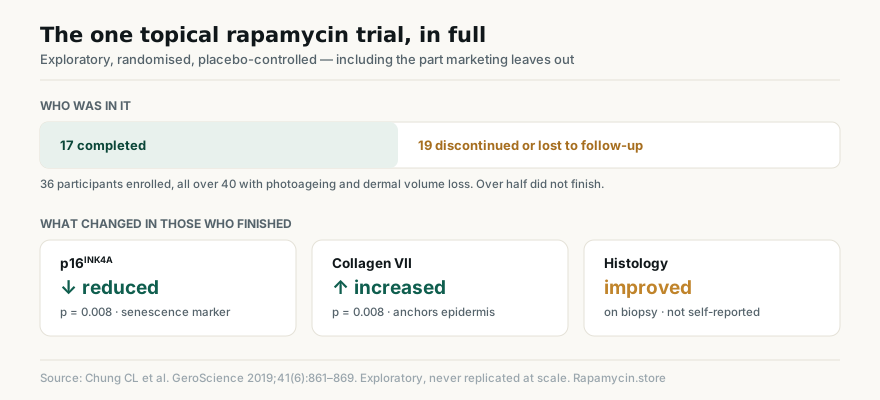
Now the limitations, which the authors were explicit about. Thirty-six participants were enrolled and nineteen discontinued or were lost to follow-up — a dropout rate above 50% in a study that small.[1] It was labelled exploratory for good reason, and no large confirmatory trial has since replaced it. A single small positive study with heavy attrition is the beginning of an evidence base, not the end of one.
One positive small trial · not replicatedWhy the skin is a reasonable target
There is a coherent biological argument here, which is more than can be said for most cosmetic ingredients. Skin ageing involves the accumulation of senescent cells that stop dividing but keep signalling inflammatory factors, and p16INK4A is one of the standard markers of that state. mTOR inhibition is one of the better-characterised ways to modulate the senescent phenotype. The trial's endpoints were chosen to test that mechanism directly rather than to produce a flattering before-and-after photo.
The systemic literature supports the plausibility from another angle: pooled human data on rapamycin and its derivatives report improvements in some skin measures alongside immune and cardiovascular ones.[3]
Topical versus oral: what actually differs
| Topical rapamycin | Oral rapamycin | |
|---|---|---|
| Target | mTOR in skin cells, locally | mTORC1 systemically |
| Systemic exposure | Low through intact skin at cosmetic concentrations | By design — that is the point |
| Evidence base | One small exploratory RCT[1] | Multiple human trials on immunity, safety and biomarkers[3] |
| Main risk | Local irritation; unstandardised compounding | Dose-dependent systemic effects[2] |
| Access | Prescription + compounding pharmacy | Prescription |
The honest limits
- Not over the counter. Getting it means a clinician and a compounding pharmacy, not a checkout button.
- Products are not standardised. Concentration and vehicle matter, and neither is regulated the way a mass-market cosmetic is.
- One trial is one trial. A 50%+ dropout rate in a 36-person exploratory study is a real caveat, not a footnote.[1]
- Do not extrapolate from the pills. Systemic rapamycin has far more longevity data; none of it transfers automatically to a cream.[5]
- Broken skin changes the maths. Absorption rises when the barrier is compromised, so damaged or inflamed skin is a medical conversation, not a self-experiment.[4]
If you arrived here from an old rapamycin-cream link, the science has moved on but the honest position has not: interesting, locally-acting, prescription-grade, with one encouraging small trial behind it — and not a proven anti-ageing shortcut. See the main rapamycin evidence guide, how people access rapamycin, and senolytics for the other side of the senescence story.
Frequently asked questions
Is topical rapamycin available over the counter?
No. Topical rapamycin is typically a compounded prescription product prepared by a compounding pharmacy on a clinician's order. It is not a standard over-the-counter cosmetic.
Does topical rapamycin work for skin ageing?
One small randomised trial in adults over 40 found reduced p16INK4A (a senescence marker) and increased collagen VII after topical rapamycin, alongside improvement in histological appearance. It is a genuine positive result, but the trial was exploratory, more than half of enrolled participants did not complete it, and no large confirmatory trial has followed. Promising, not proven.
Is topical rapamycin safer than the pill?
The rationale is that local skin application inhibits mTOR in the skin without the systemic immune suppression of oral dosing. That is plausible and consistent with how the trial reported tolerability, but it does not make it risk-free — and quality and concentration vary between compounded products.
What concentration of topical rapamycin is used?
Compounded anti-ageing preparations are typically formulated in the region of 0.001% to 0.01% rapamycin, applied to the face. There is no consensus standard, which is precisely the problem: two products described the same way may not be comparable.
How long does topical rapamycin take to work?
The published trial ran for eight months before measuring its biopsy endpoints. Anyone promising a visible result in a fortnight is describing marketing, not the study.
Is topical rapamycin better than retinol?
Topical retinoids have decades of replicated trial evidence for photoageing; topical rapamycin has one small exploratory trial. On evidence weight alone the retinoid wins comfortably today. The interesting question is whether they do different things — retinoids drive turnover, rapamycin appears to act on cellular senescence — not which is fashionable.
Can topical rapamycin be absorbed into the bloodstream?
Absorption through intact skin at cosmetic concentrations is low, and blood levels in dermatologic use are typically negligible to undetectable. Absorption rises when the skin barrier is broken, which is a reason not to apply it to damaged or inflamed skin without medical advice.
Is topical rapamycin used for anything approved?
Yes. Topical sirolimus is established in dermatology for the facial angiofibromas of tuberous sclerosis complex, which is what makes the anti-ageing question worth asking at all — the safety of putting this molecule on facial skin is not being invented from scratch.
References
- Topical rapamycin reduces markers of senescence and aging in human skin: an exploratory, prospective, randomized trial. Chung CL et al. GeroScience 2019;41(6):861–869.n=36 enrolled, 19 discontinued; lower p16INK4A (p=0.008), higher collagen VII (p=0.008).
- Rapamycin for longevity: the pros, the cons, and future perspectives. Roark KM, Iffland PH. Frontiers in Aging 2025;6:1628187.Peer-reviewed review, cited 31 times.
- Targeting ageing with rapamycin and its derivatives in humans: a systematic review. Lee DJW et al. The Lancet Healthy Longevity 2024.Systematic review, cited 189 times.
- Sirolimus. Wikipedia.
- Rapamycin — topic overview. FoundMyFitness.
Own a longevity or health brand?
Rapamycin.store publishes sponsored and guest posts on an aged, topically-relevant domain, and offers display advertising. Tell us what you want to promote and we'll send our current options.