The evidence roundup
Longevity supplements ranked by the evidence
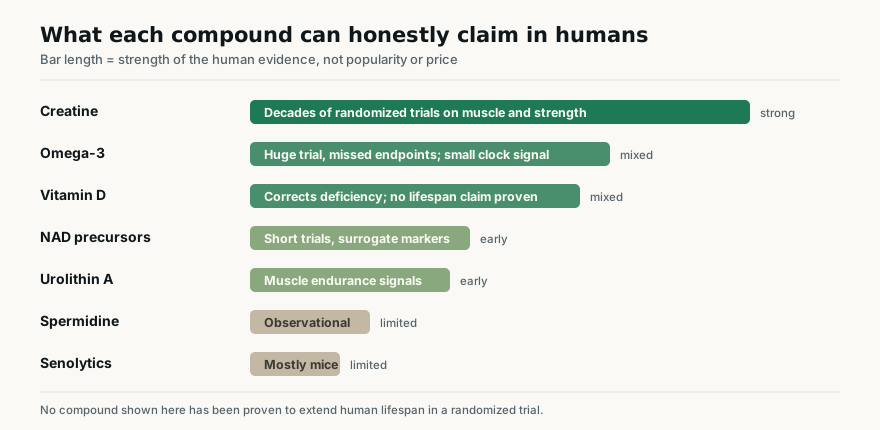
The best longevity supplements, ranked here by human trials, include two that VITAL followed in 25,871 adults for 5.3 years without meeting its primary endpoints. The one randomized aging-clock signal came from 1 g of omega-3 a day over 3 years.

The short version
Most roundups of longevity supplements rank by search volume, not by trials that ran for 3 to 5 years. This page uses one stated criterion: how strong is the human evidence, and for what claim.
That criterion reorders the field. The compounds with the deepest trial record are rarely sold as anti-aging, while vitamin D and omega-3, top of most lists, missed their primary endpoints in the largest randomized trial in this space.[1]
| Product | Evidence | Typical dose | 3rd-party tested | Best for | Not for | Price band |
|---|---|---|---|---|---|---|
| Creatine monohydrate | Strong human evidence | 3 to 5 g daily | Not stated | preserving muscle and strength with age | anyone expecting a rapid or dramatic effect | $ · budget |
| Omega-3 (EPA and DHA) | Early / mixed evidence | about 1 g daily in DO-HEALTH | Not stated | a dietary foundation with one small biological-aging signal | a proven cardiovascular or cancer benefit | $ · budget |
| Vitamin D | Early / mixed evidence | dose set by your measured level | Not stated | correcting a documented deficiency | adding years to an already-adequate person | $ · budget |
| NAD precursors (NR or NMN) | Early / mixed evidence | 250 to 500 mg daily in trials | Not stated | raising NAD+ and early metabolic signals | anyone wanting proven hard outcomes | $$ · mid |
| Urolithin A | Early / mixed evidence | 500 to 1000 mg daily | Not stated | mitochondrial and muscle-endurance markers | a settled longevity claim | $$$ · premium |
| Spermidine | Limited evidence | 1 to 6 mg daily from food or extract | Not stated | an autophagy-linked dietary angle | those needing trial-proven benefit | $$ · mid |
| Senolytics (fisetin, quercetin) | Limited evidence | intermittent high-dose protocols under study | Not stated | following an active research area | unsupervised self-experimentation | $ · budget |
Affiliate links. We may earn a commission; it does not change our assessments.
How we rank: the evidence ladder
A ranking is only useful if you know what it measures. Ours has four rungs, and every compound on this page is placed on one of them.
- Randomized human outcome data. A trial that measured something a person experiences, such as strength, a disease event or death, and reported what happened.
- Randomized human surrogate data. A trial that measured a marker believed to track with aging, such as NAD+ levels or an epigenetic clock.
- Observational human data. Populations that consume more of something appear to do better, with all the confounding that implies.
- Animal data only. Real, often striking, and historically a poor predictor of what happens in people.
Almost every claim in the longevity supplement aisle rests on rung two or lower. The problem is marketing that writes rung-two results in rung-one language.
Are there any anti-aging supplements that actually work?
Yes, in a narrower sense than the question implies. Several of these compounds reliably do the specific biochemical thing they claim to do. NAD precursors raise NAD+ (the NMN products are compared here).
Urolithin A shifts mitochondrial and muscle-endurance markers.[2] Creatine improves strength and lean mass across a very large trial literature.[3]
What no trial has shown
What none of them has done is demonstrate, in a randomized trial, that a person taking them lives longer or stays healthy for longer. The hallmarks-of-aging framework that underpins the field is a map of processes worth targeting, not a claim that any product on sale has successfully targeted them.[4]
The trial nobody on page one mentions
Vitamin D and marine omega-3, which top most lists, were the subject of VITAL, which randomized 25,871 US adults and followed them for a median of 5.3 years. Supplementation with vitamin D did not lower the incidence of invasive cancer or major cardiovascular events compared with placebo, and neither did omega-3.[5]
Later pooled analyses of VITAL alongside other vitamin D trials did find a significant reduction in cancer mortality, without a reduction in cancer incidence or cardiovascular endpoints.[6] That is real, and far narrower than a number-one ranking implies.
Deficiency is not lifespan
Early / mixed evidence The most useful point on this page: correcting a deficiency and extending a lifespan are different claims. Vitamin D matters when your level is genuinely low, which is common in older adults. Supplementing an already-adequate person in the hope of buying years is not something VITAL supports.
Show the numbers as a table
| When | Event | Detail |
|---|---|---|
| 2016 | Metformin trial design | TAME proposal |
| 2017 | Creatine safety review | ISSN position stand |
| 2018 | NR raises NAD+ | older adults |
| 2019 | VITAL misses endpoints | vitamin D and omega-3 |
| 2020 | Pooled VITAL analysis | lower cancer mortality |
| 2025 | DO-HEALTH clock signal | omega-3, small effect |
What supplement is best for anti-aging?
By the criterion above, creatine monohydrate. It has decades of randomized human trials, it costs very little, and the thing it improves is the thing most tightly bound to independence in later life: muscle mass and strength.[7] Its evidence is strong partly because sports scientists, with no incentive to call it a longevity compound, ran most of the trials.
What are the top 5 supplements for longevity?
Ordered by evidence rather than by how often they appear in a listicle:
- Creatine monohydrate. Randomized human outcome data on a function that matters with age.
- Omega-3. The largest trials missed their endpoints, but it carries the one randomized biological-aging signal in the field.
- Vitamin D, if you are deficient. A conditional entry, and the condition is a blood test rather than a marketing page.
- An NAD precursor. Reliable effect on the marker, unproven effect on anything you would feel.
- Urolithin A. The best-designed of the newer compounds, with genuine muscle-endurance data and a premium price.
Resveratrol, collagen, CoQ10 and most multivitamins miss the list: their human evidence for a longevity claim is weaker than their shelf presence suggests.
Tier 1: the unglamorous foundations
Creatine, omega-3 and, conditionally, vitamin D share large trial literatures, low cost and modest claims that survive scrutiny. Vitamin D earns a place only if your own level says so, and if total daily protein is inadequate, no capsule below compensates.
Tier 2: promising, and early
NAD precursors and urolithin A both have randomized human trials that measured markers rather than outcomes. Nicotinamide riboside has been shown to raise NAD+ metabolites and, in one trial, to reduce systolic blood pressure and arterial stiffness in a small group of older adults, a suggestive result.[8] We cover what the NAD precursor trials actually measured at length.
Urolithin A is the better-designed newcomer, with trial data on mitochondrial gene expression and muscle endurance in older adults.[9] It is also the most expensive item here, and we set out urolithin A and the mitochondrial evidence in full elsewhere.
Spermidine, at the edge of the tier
Spermidine sits at the edge of this tier: the human data is largely observational, drawn from dietary intake in population cohorts.[10]
Tier 3: research-stage
Senolytics such as fisetin and quercetin, resveratrol, GlyNAC and CoQ10. The senolytic case rests overwhelmingly on mouse work plus a handful of small, short human pilots, and we lay out the senolytic case, unvarnished separately. Resveratrol has a long human trial record that has, on balance, been disappointing relative to its early promise.
Enter this tier knowing you are funding your own pilot study of one.
Tier 4: prescription drugs, not supplements
Rapamycin and metformin appear on supplement lists constantly, but both are prescription medicines with real side effects and interactions. Rapamycin has the strongest animal lifespan record in this field and no proven human lifespan benefit,[11] while metformin's longevity case is still being formally tested.[12]
Start with our guide to rapamycin, the most-studied of them. This page will not suggest where to obtain either without a clinician.
What supplements should you take for longevity?
A defensible sequence, rather than a shopping list:
- Fix what is measurably wrong. Bloodwork first. Correcting a real deficiency has a better expected value than anything speculative.
- Add creatine if you are training. Cheapest strong-evidence item in the guide, and it compounds with the exercise that is doing most of the work.
- Consider omega-3 as a dietary baseline. Modest expectations, low cost, one interesting clock result.
- Then, if the budget allows, pick one tier-two compound. One, not four, so that you can attribute anything you observe.
Which longevity blend supplement is the best?
A proprietary blend lists ingredients without the milligrams of each, so you cannot check any of them against the trial that supplied its credibility. A product borrowing the reputation of a 500 mg urolithin A trial while supplying 40 mg is doing something the label makes impossible to detect.
Blends also make personal experimentation useless. Take eight things at once and you learn nothing about which one did anything. Single ingredients at stated doses are cheaper, checkable and testable.
What increases longevity the most?
Nothing sold in a bottle. Not smoking, staying metabolically healthy, sleeping adequately and doing regular resistance training have effect sizes that no compound in this guide approaches. Supplements are a rounding error applied to that foundation.
What is the Japanese approach to anti-aging?
The Okinawan longevity story that gets recycled into supplement marketing is a story about diet pattern, physical activity woven into daily life, social connection and modest caloric intake. It is not a story about a compound, and no capsule extracted from it has reproduced the population effect.
Raising a marker is not the same as living longer
This is the distinction that decides how you should read every claim in the category. A surrogate endpoint is a measurement believed to track the outcome you care about. Trials in this field overwhelmingly report surrogates, because outcomes take decades and cost fortunes.
The one clock result omega-3 has
A post-hoc analysis of the DO-HEALTH trial reported that 1 g a day of omega-3 over three years produced a small protective effect across several DNA methylation clocks, amounting to a few months of biological age.[13] It is the strongest randomized aging-clock signal any supplement has, from the compound that missed its hard endpoints in VITAL.
Limited evidence Both results hold because the trials measured different things. Anyone quoting the clock result without the endpoint result, or the reverse, is selling you half a picture.
What a proven longevity supplement would have to show
Nothing has cleared this bar:
- A randomized, placebo-controlled trial in humans, adequately powered.
- A pre-specified primary endpoint that is an outcome, not a marker.
- Years of follow-up, not weeks.
- Replication by a group with no commercial stake in the answer.
Every compound here is a candidate rather than a treatment. The field is early, not fraudulent.
Do the cost arithmetic before the shortlist
Cost per day reorders these lists. Divide the price by the number of servings rather than the number of capsules, because a two-capsule serving halves the bottle you thought you bought.
Side by side, creatine typically lands at cents a day with the strongest evidence in the guide. A premium tier-two compound can run several dollars a day for surrogate-marker data. See that trade before you subscribe.
Best longevity supplements for men and for women
The mechanisms behind the compounds with real evidence are not sex-specific,. Where the answer genuinely diverges is in baseline risk: bone density considerations after menopause make vitamin D and calcium status more consequential, and iron status runs in opposite directions across the two groups.
Useful personalization comes from your own bloodwork and history, not the demographic printed on the tub.
Who should be careful
Anyone taking prescription medication, anyone with kidney or liver disease, anyone pregnant or breastfeeding, and anyone about to undergo surgery. Interactions depend on what else you take, so ask a pharmacist.
The other group worth naming is anyone tempted to copy a high-dose intermittent protocol from a research paper. Copying the dose without the monitoring is not copying the study.
How to read a label without being sold to
- The exact molecule. Named precisely, not as a category or a trademarked blend name.
- Milligrams per serving. Of that molecule, and with the serving size stated in capsules.
- Third-party testing. Ask for the certificate of analysis. A company that has one will send it.
- Cost per day at the labeled serving. Calculated by you, before purchase.
Shelf presence is not a regulatory review
No supplement on this page was checked by the FDA before it reached the shelf. Under US rules a label may say something like "supports cellular energy" only beside a disclaimer that the agency has not evaluated it, and it may not claim to treat or prevent a disease.[14]
Proving the claim is the manufacturer's job. So "clinically studied" tells you nothing about whether this product works or holds the dose on the label; the certificate of analysis above is the check that does.
- What this does not say:
- Describes the US framework only; the FDA can act after marketing, and third-party certification programs add checks the law does not require.
Running your own trial of one
If you are going to spend the money, get information out of it. Decide the measure, the period and the stopping result before you start, and change one thing at a time.
If you want an objective baseline rather than a subjective impression, see our guide to measuring whether anything changed. A three-month test with a defined endpoint is worth more than three years of an unexamined subscription.
Where the explainers live
Every explainer behind these rankings sits in our longevity science guides.
Some of these compounds move a marker, and a few are cheap enough to try under uncertainty. None has been shown to extend a human life.
Frequently asked questions
If VITAL was negative, why do vitamin D and omega-3 still top most lists?
Because most lists rank by popularity, not by endpoint. VITAL tested whether either supplement lowered invasive cancer or major cardiovascular events, and neither did. Later pooled analyses found a cancer mortality signal for vitamin D without fewer cancers, which is real and far narrower than a number-one ranking implies.
Is a few months of epigenetic age worth three years of omega-3?
That depends on how much weight you give a clock. The DO-HEALTH signal came from a post-hoc analysis: 1 g a day over three years moved several DNA methylation clocks by a few months. It is a surrogate from a secondary analysis, from the same compound that missed its hard endpoints in VITAL.
If only one supplement fits the budget, which has the deepest evidence?
Creatine monohydrate, on this page's criterion. It has decades of randomized human trials, costs very little, and improves muscle mass and strength, the decline most tied to independence later in life. That is an evidence ranking, not a personal recommendation, and bloodwork showing a real deficiency changes the order.
What supplements should you take for longevity?
Start with whatever corrects a documented gap in your own bloodwork, then add creatine if you are training. Beyond that you are buying probability, not benefit. Take one thing at a time, know what you are measuring, and set a date to review it.
Does a blend do anything a single ingredient does not?
Blends are the hardest format to defend, because a proprietary label hides the dose of each ingredient. If you cannot see the milligrams, you cannot check them against the trial they are borrowing credibility from. Single ingredients at stated doses are easier to evaluate and usually cheaper.
What increases longevity the most?
Not a supplement: not smoking, staying metabolically healthy, sleeping properly and doing resistance training have effect sizes no capsule in this category comes near. Supplements sit on top of that foundation rather than substituting for it.
Has any supplement slowed biological aging in a randomized trial?
One signal exists: a post-hoc analysis of the DO-HEALTH trial found that 1 g a day of omega-3 over three years produced a small protective effect across several DNA methylation clocks, on the order of a few months of biological age. As a surrogate from a secondary analysis, it is a signal, not a settled result.
Do longevity supplements have side effects?
Most in the first two tiers are well tolerated at studied doses. The real risks are interactions with prescription medication, high-dose protocols copied from research settings, and buying from brands with no third-party testing. A five-minute conversation with a pharmacist covers the first risk better than any article.
Are these supplements FDA approved?
No. Dietary supplements are not evaluated by the FDA for efficacy before sale. Label phrases such as supports cellular energy are a permitted regulatory category, not a trial result, and reading them as evidence is the single most common mistake in this category.
Are the best longevity supplements different for men and women?
For the compounds with real evidence, the mechanisms are not sex-specific. What differs is the baseline risk profile, so the useful personalization comes from your own bloodwork and history rather than from a pink or blue label. Bone density and iron status are the two places where the answer genuinely diverges.
References
12 sources, all link-checked; oldest check
- Vitamin D supplements and prevention of cancer and cardiovascular disease. Manson JE et al. New England Journal of Medicine 2019 (VITAL; cited 2,159).25,871 participants, median 5.3 years: vitamin D did not lower the incidence of invasive cancer or cardiovascular events versus placebo.Publisher blocks automated checks · last tried Sep 15, 2026
- Marine n-3 fatty acids and prevention of cardiovascular disease and cancer. Manson JE et al. New England Journal of Medicine 2019 (VITAL; cited 1,276).Same trial, omega-3 arm: no reduction in major cardiovascular events or cancer versus placebo.Publisher blocks automated checks · last tried Sep 15, 2026
- Principal results of the VITamin D and OmegA-3 TriaL (VITAL) and updated meta-analyses. Manson JE et al. J Steroid Biochem Mol Biol 2020 (cited 213).Pooled reading: a significant reduction in cancer mortality but not in cancer incidence or cardiovascular endpoints.Verified Sep 15, 2026
- Individual and additive effects of vitamin D, omega-3 and exercise on DNA methylation clocks of biological aging in older adults. Bischoff-Ferrari HA et al. Nature Aging 2025 (DO-HEALTH; cited 141).Post-hoc analysis: 1 g/day omega-3 over three years produced a small protective effect on several epigenetic clocks, on the order of a few months of biological age.Verified Sep 15, 2026
- International Society of Sports Nutrition position stand: safety and efficacy of creatine supplementation. Kreider RB et al. Journal of the International Society of Sports Nutrition 2017;14:18.Verified Sep 15, 2026
- Chronic nicotinamide riboside supplementation is well-tolerated and elevates NAD+ in healthy middle-aged and older adults. Martens CR et al. Nature Communications 2018;9:1286.Randomized, placebo-controlled; raised NAD+, no clear functional outcome.Verified Sep 15, 2026
- The mitophagy activator urolithin A is safe and induces a molecular signature of improved mitochondrial and cellular health in humans. Andreux PA et al. Nature Metabolism 2019;1:595–603.First-in-human; authors affiliated with Amazentis (Timeline); note conflict.Verified Sep 15, 2026
- Higher spermidine intake is linked to lower mortality: a prospective population-based study. Kiechl S et al. American Journal of Clinical Nutrition 2018;108(2):371–380.Observational (Bruneck cohort): association, not proof of causation.Verified Sep 15, 2026
- Hallmarks of aging: an expanding universe. López-Otín C et al. Cell 2023;186(2):243–278.Updated framework: twelve hallmarks.Publisher blocks automated checks · last tried Sep 15, 2026
- Rapamycin for longevity: the pros, the cons, and future perspectives. Roark KM, Iffland PH. Frontiers in Aging 2025;6:1628187.Peer-reviewed review, cited 31 times.Verified Sep 15, 2026
- Metformin as a tool to target aging. Barzilai N et al. Cell Metabolism 2016;23(6):1060–1065.Rationale for the TAME (Targeting Aging with Metformin) trial.Publisher blocks automated checks · last tried Sep 15, 2026
- Structure/Function Claims: Small Entity Compliance Guide. US Food and Drug Administration.Why supplement labels may not claim to treat disease, and what the disclaimer on every label means.Verified Sep 15, 2026
Every link above is re-requested on a schedule by an automated checker; the date shown is when it last answered. Publishers that block automated requests are marked as such rather than reported broken. Our editorial standards explain how a source gets cited here in the first place.
Filed by the Rapamycin.store evidence desk. Each source is re-checked when the page is reviewed.
Own a longevity or health brand?
Rapamycin.store publishes sponsored and guest posts on an aged, topically-relevant domain, and offers display advertising. Tell us what you want to promote and we'll send our current options.