The evidence guide
Metformin for longevity: what the evidence actually supports
Metformin for longevity is a hope, not a result: in a 12-week randomized trial of older adults (Konopka 2019), the drug blunted the gains from aerobic training. The trial designed to settle the question still has not reported.

The short version
Metformin for longevity rests partly on a 5.8% mean lifespan increase in model organisms (per the 2025 Keys review). It is cheap, generic and backed by decades of safety data.
It also has a genuinely interesting mechanistic story connecting it to nutrient sensing, one of the central themes in the biology of aging.[1]
- Human data: observational, in people with diabetes.
- Animal data: modest, and shrinking under scrutiny.
- Outcome trial: designed, not reported.
What it does not have is evidence that it extends healthy life in people who do not have diabetes. That has been true for years, and over the last two the picture has become less encouraging rather than more.
Where the metformin longevity idea came from
The founding observation was that diabetic patients taking metformin appeared to survive longer than matched controls who did not have diabetes at all. If true and causal, that is remarkable: a treated disease population outliving a healthy one implies the drug is doing something beyond glucose control.
That result was compelling enough to launch a research program and a proposed trial.[2] It is also exactly the kind of comparison where confounding is hard to eliminate.
| Evidence | Study type | Population | Outcome reported |
|---|---|---|---|
| Diabetic survival comparison[2] | Observational cohort | People with diabetes on metformin vs matched controls without diabetes | Treated patients appeared to survive longer; confounding not excluded |
| 2025 Keys review[3] | Review of animal studies | Model organisms | 5.8% mean lifespan increase |
| Monkey aging clocks[5] | Primate study | Treated monkeys | Protein age about 6.41 years lower; a biomarker, not lifespan |
| Exercise training trial[6] | Randomized trial, 12 weeks | Older adults doing aerobic training | Metformin blunted mitochondrial adaptations to exercise |
| TAME[7] | Proposed multi-center trial | Older adults | No efficacy results published |
Why prescribing patterns confound the result
Who gets prescribed metformin, at what stage of disease, with what comorbidities and what adherence, are all non-random. Observational pharmacoepidemiology has produced many findings of this shape that did not survive randomization.
They were more obese and had more diseases to start, and still they had 17% lower mortality.
Why the case for metformin for longevity has been getting weaker
Three things have moved in the same direction.
Smaller animal effects and closer scrutiny
Animal effect sizes look smaller on close inspection than the early enthusiasm suggested, with reported mean lifespan increases in model organisms in the single-digit percentages.[3] The confounding in the human observational data has been examined more carefully. And a 2025 review of the field is framed explicitly around emerging uncertainty about the anti-aging potential of the drug.
What recent reviews still conclude
Early / mixed evidence Reviews of the case for metformin for longevity continue to take it seriously and to ask the more refined question of who might benefit rather than whether anyone does.[4]
But anyone who formed a view of metformin from coverage published five years ago is holding a more optimistic picture than the current literature supports.
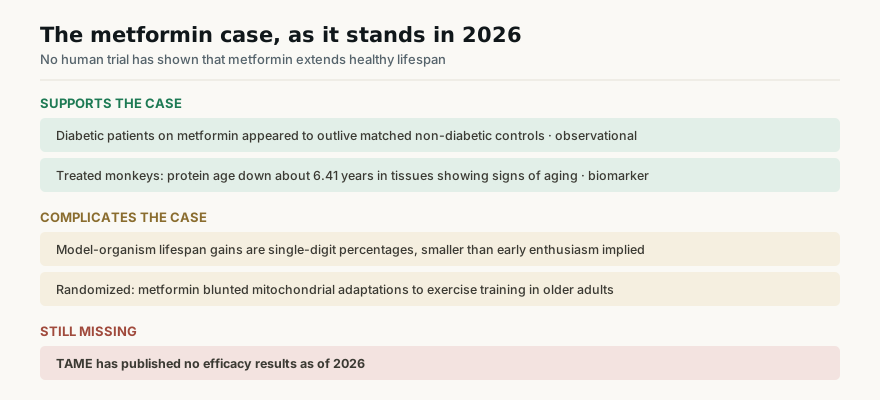
The monkey aging-clock result
The most encouraging recent finding is in monkeys, not humans. That work reported that metformin decelerated biomarkers of aging clocks, with protein age decreasing by an average of about 6.41 years in treated animals.[5] It is a serious primate result and a biomarker result, which is the distinction the whole field turns on.
The exercise finding that deserves more attention
A randomized study in older adults found that metformin inhibited mitochondrial adaptations to aerobic exercise training.[6] Participants exercising while taking metformin got less of the training response than those exercising without it.
Why a blunted training response matters
This is more consequential than it usually gets credit for. Exercise has stronger evidence for healthy aging than anything in a bottle or a blister pack, including metformin. A drug taken speculatively for longevity that measurably reduces the benefit of the intervention with the best longevity evidence is a genuine trade, not a footnote.
If you train, the drug may take back part of the benefit
The detail matters for anyone who exercises. In that trial, 53 older adults without diabetes did 12 weeks of aerobic training on metformin or placebo (per Konopka 2019). The placebo group gained muscle mitochondrial respiration; the metformin group did not, and its gains in insulin sensitivity and aerobic capacity were smaller.
So the practical question is not only whether the drug helps. It is whether it quietly subtracts from the habit that already works. For a regular exerciser, that measured cost sits against a benefit nobody has shown.
- What this does not say
- Older adults without diabetes on 12 weeks of aerobic training; in the MASTERS resistance-training trial (Walton et al., Aging Cell 2019) metformin also blunted muscle gains; people with diabetes were not studied.
What is the status of TAME?
TAME, Targeting Aging with Metformin, was designed to test whether the drug delays the onset of age-related diseases considered as a group rather than one at a time.[7] Part of its purpose was regulatory: to establish that aging itself could be an approvable indication, which would change how every subsequent longevity drug is developed.
The other geroprotector class it would open the door to is covered in our senolytics review. Any page describing metformin as a proven longevity drug is describing a trial that has not reported.
TAME is still a proposal, whatever the marketing implies
Supplement and telehealth copy cites TAME as though it had delivered a verdict. Its sponsor describes it as a proposed multi-center trial, and it has published no efficacy results.
That means the human case for taking metformin to slow aging still rests on observational comparisons in people with diabetes. When a seller leans on TAME, read it as a question being asked, not an answer.
- What this does not say:
- Sponsor's own page; funding and start dates have shifted over years, so status should be rechecked before citing.
Show the numbers as a table
| When | Event | Detail |
|---|---|---|
| 2016 | TAME rationale | Cell Metabolism paper |
| 2019 | Exercise blunted | 12-week randomized trial |
| 2024 | Monkey clocks slow | biomarker, not lifespan |
| 2025 | Emerging uncertainty | review of the field |
| 2026 | TAME unreported | no efficacy results |
What happens if I take metformin without being diabetic?
Metformin works principally by reducing hepatic glucose output and improving insulin sensitivity. In someone whose glucose regulation is already normal, there is less to correct, and the blood sugar effect is correspondingly modest.
The side effects people actually get
What people do reliably experience is the side-effect profile: gastrointestinal upset in the first weeks is common and usually settles. Over years, reduced vitamin B12 absorption is common enough that periodic testing is routine practice. Those are the known costs, and they are being accepted in exchange for a benefit that has not been shown in this population.
How much metformin do people take for longevity?
Off-label use of metformin for longevity generally follows diabetes dosing, commonly 500 mg to 1,000 mg a day and often in extended-release form to reduce gastrointestinal effects. Some protocols circulating online go higher.
Why no longevity dose exists
No dose has been established for a longevity indication, for the straightforward reason that no longevity indication has been established. Every number in circulation is borrowed from the diabetes literature. Our guide to where the metformin dose numbers come from traces each one back.
Who should not take metformin?
Significantly reduced kidney function is the central contraindication, because metformin is cleared renally and accumulation raises the risk of lactic acidosis. That complication is rare and serious, and it is the reason eligibility is decided by kidney function rather than preference.
Other exclusions and cautions
Also excluded or requiring care: anyone with acute illness causing dehydration or reduced tissue oxygen delivery, anyone with severe liver disease, anyone with a history of significant alcohol misuse, and anyone about to undergo imaging with iodinated contrast, where temporary suspension is standard. These are prescriber decisions and they are the reason this drug is prescription-only.
Metformin or rapamycin?
The two most-discussed prescription candidates in this field have opposite profiles. Rapamycin has the stronger and more replicated animal lifespan record, including in the field's most rigorous mouse program, and a much smaller human safety database for this use.[8] Metformin has decades of human safety data across millions of patients and a weakening animal and observational case.
What neither drug has shown
Neither has demonstrated a lifespan benefit in humans. Both are prescription decisions made with a clinician. We set out the comparison in full in the head-to-head on rapamycin and metformin, including where each one's evidence is strongest.
The rapamycin trials themselves are laid out in our rapamycin evidence guide.
Should a healthy person take metformin for aging?
On the current evidence there is no clear case. The benefit is unproven in non-diabetic adults, the side effects are real if usually manageable, the exercise finding is a specific and measured cost, and the definitive trial has not reported.
That is a defensible reason to wait on metformin for longevity rather than a reason to dismiss the drug. Nobody taking the drug today is acting on a demonstrated human benefit. The prescription class that does have hard-outcome data is covered in our GLP-1 longevity review.
What would change the picture
The mechanism remains interesting, the safety record is genuinely reassuring, and TAME reporting would change the picture substantially. Where metformin sits against the rest of the field is set out in our guide to ranking longevity interventions by evidence, which places prescription drugs in their own tier for good reason.
Frequently asked questions
What happens if I take metformin without being diabetic?
In people with normal glucose metabolism, metformin lowers blood sugar only modestly, because its main action is on hepatic glucose output. The most common experience is gastrointestinal side effects for the first weeks. The longevity benefit people are hoping for has not been demonstrated in non-diabetic adults.
Has metformin been proven to extend human lifespan?
No. The idea rests on observational data in diabetic patients, animal work with modest effect sizes, and mechanism. The trial designed to test it properly, TAME, has published no efficacy results as of 2026. Nobody is currently able to say metformin extends healthy human lifespan.
Where did the metformin longevity idea come from?
From an observational finding that diabetic patients taking metformin appeared to survive longer than matched non-diabetic controls. That result was striking enough to launch a field, and it is also the kind of comparison where treatment selection and disease severity confound the answer heavily.
Does metformin blunt exercise benefits?
There is real evidence that it can. A randomized study in older adults found metformin inhibited mitochondrial adaptations to aerobic exercise training. That matters a great deal, because exercise has better evidence for healthy aging than metformin does, and blunting it is a genuine cost.
What is the TAME trial and has it reported?
TAME, Targeting Aging with Metformin, is the proposed multi-center trial designed to test whether metformin delays the onset of age-related diseases as a group. Its design was intended partly to establish aging itself as a treatable indication. It has published no efficacy results as of 2026.
What happens when you take metformin for years?
Long-term use is associated with vitamin B12 deficiency, which is common enough that periodic testing is standard practice. Gastrointestinal effects usually settle. Lactic acidosis is rare but serious and is why kidney function determines eligibility.
Why do I feel so good on metformin?
Some people report improved energy and appetite regulation, and if blood sugar was previously dysregulated, that is a real and explicable effect. In someone metabolically healthy there is no established mechanism for feeling better, and expectation effects in this space are substantial.
What are the early signs metformin is working?
For its actual indication the answer is glucose readings and HbA1c, measured rather than felt. For the longevity use there are no early signs, because there is no established endpoint to look for. Anyone describing early anti-aging signs is describing an expectation.
Can metformin help you look younger?
No trial supports an appearance claim. The aging-related data concerns biomarkers, disease incidence and epigenetic measures, not skin or visible aging. This is one of the clearer cases of a claim running far ahead of anything measured.
Which is safer, Ozempic or metformin?
They are different drugs for overlapping purposes, and safety depends entirely on the person and the indication. Metformin has decades of use and a well-mapped profile, while GLP-1 drugs are newer with a different side-effect pattern. This comparison belongs with a prescriber who knows your history, not with a website.
Does metformin slow epigenetic aging?
There is a real signal in animals. Work in monkeys reported protein age decreasing by an average of about 6.41 years in treated animals, in tissues showing signs of aging. That is a striking result in a primate model and it is not a human outcome.
How much metformin do people take for longevity?
Off-label longevity use typically follows diabetes dosing, commonly 500 mg to 1,000 mg a day, often extended release. No dose has been established for a longevity indication because no longevity indication has been established.
Can I get metformin for anti-aging?
It is a prescription drug in most countries and any longevity use is off-label. That decision belongs to a licensed prescriber who can assess your kidney function and medication list. This site does not point anyone toward unregulated sources.
Who should not take metformin?
Anyone with significantly reduced kidney function, which is the central contraindication because of lactic acidosis risk. Also anyone with acute conditions causing dehydration or tissue hypoxia, anyone with severe liver disease, and anyone about to have imaging with iodinated contrast without prescriber guidance.
Does metformin cause B12 deficiency?
Long-term use is associated with reduced B12 absorption often enough that monitoring is routine clinical practice. It is straightforward to detect and to correct, which makes it a manageable issue rather than a reason to avoid the drug.
How does metformin compare with rapamycin for aging?
Rapamycin has the stronger and more replicated animal lifespan record. Metformin has the larger human safety database, because millions of people have taken it for decades. Neither has demonstrated a lifespan benefit in humans and both are prescription decisions.
Is the metformin longevity case getting stronger or weaker?
Weaker over the last few years. A 2025 review is titled around emerging uncertainty on the anti-aging potential of metformin, animal effect sizes have looked smaller on closer inspection, and the definitive trial has not reported. The mechanism remains interesting.
Should a healthy person take metformin for aging?
On the current evidence, no clear case exists. You would be accepting known side effects and a documented risk of blunting exercise adaptations, in exchange for a benefit that has not been demonstrated in people like you. That trade may change if TAME reports, but it has not changed yet.
References
8 sources, all link-checked; oldest check
- Emerging uncertainty on the anti-aging potential of metformin. Keys MT et al. 2025 (cited 20).Recent review re-examining the metformin longevity case, including the 5.8% mean lifespan increase reported in model organisms and the confounding in the human observational data.Publisher blocks automated checks · last tried Sep 15, 2026
- Metformin as anti-aging therapy: is it for everyone?. Soukas AA, Hao H, Wu L. Trends in Endocrinology and Metabolism 2019 (cited 314).Review of the anti-aging case and its limits, including the question of who might not benefit.Verified Sep 15, 2026
- Metformin as a tool to target aging. Barzilai N et al. Cell Metabolism 2016;23(6):1060–1065.Rationale for the TAME (Targeting Aging with Metformin) trial.Publisher blocks automated checks · last tried Sep 15, 2026
- Metformin inhibits mitochondrial adaptations to aerobic exercise training in older adults. Konopka AR et al. Aging Cell 2019;18(1):e12880.Publisher blocks automated checks · last tried Sep 15, 2026
- Metformin decelerates biomarkers of aging clocks. Abou Zaki R et al. 2024 (cited 28).In treated monkeys, protein age decreased by an average of 6.41 years across tissues showing signs of aging.Verified Sep 15, 2026
- TAME: Targeting Aging with Metformin. American Federation for Aging Research.The proposed multi-center trial designed to test whether metformin delays age-related disease; as of 2026 it has published no efficacy results.Publisher blocks automated checks · last tried Sep 15, 2026
- Rapamycin for longevity: the pros, the cons, and future perspectives. Roark KM, Iffland PH. Frontiers in Aging 2025;6:1628187.Peer-reviewed review, cited 31 times.Verified Sep 15, 2026
- Hallmarks of aging: an expanding universe. López-Otín C et al. Cell 2023;186(2):243–278.Updated framework: twelve hallmarks.Publisher blocks automated checks · last tried Sep 15, 2026
Every link above is re-requested on a schedule by an automated checker; the date shown is when it last answered. Publishers that block automated requests are marked as such rather than reported broken. Our editorial standards explain how a source gets cited here in the first place.
Filed by the Rapamycin.store evidence desk. Each source is re-checked when the page is reviewed.
Own a longevity or health brand?
Rapamycin.store publishes sponsored and guest posts on an aged, topically-relevant domain, and offers display advertising. Tell us what you want to promote and we'll send our current options.