The evidence guide
Collagen for longevity: the glycine question nobody asks
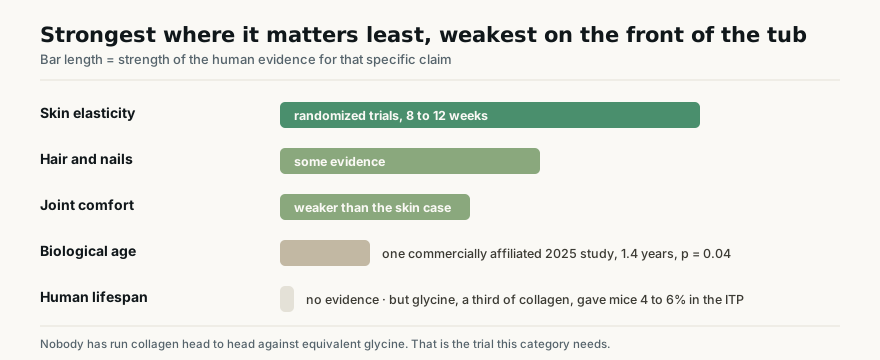
The case for collagen for longevity rests on one 2025 study reporting a 1.4 year drop in an aging-clock estimate, while its skin evidence comes from trials lasting 8 to 12 weeks. The most interesting argument for it is about a single amino acid.

The short version
The evidence for collagen for longevity is one 2025 study reporting a 1.4 year drop in an aging-clock estimate. Its skin evidence, from trials of 8 to 12 weeks, is better than most of what this field offers. Its longevity evidence is almost nonexistent by comparison, apart from one genuinely interesting 2025 paper that few people discuss.
Underneath all of it sits a question the industry has no incentive to ask: is collagen doing something as collagen, or is it a delivery vehicle for glycine?
| Product | Evidence | Typical dose | 3rd-party tested | Best for | Not for | Price band |
|---|---|---|---|---|---|---|
| Collagen peptides for skin | Early / mixed evidence | 2.5 to 10 g daily in trials | Not stated | skin elasticity and hydration over 8 to 12 weeks | anyone expecting rapid or dramatic visible change | $$ · mid |
| Collagen for joints | Limited evidence | 10 g daily in most products | Not stated | joint comfort, on weaker evidence than the skin case | a demonstrated structural effect on cartilage | $$ · mid |
| Collagen for longevity | Limited evidence | no established longevity dose | Not stated | following a single commercially affiliated 2025 study | anyone wanting independent replication | $$ · mid |
| Glycine on its own | Limited evidence | studied in mice, not established in humans | Not stated | the amino acid with an actual ITP lifespan result behind it | anyone assuming mouse results transfer to people | $ · budget |
Affiliate links. We may earn a commission; it does not change our assessments.
What collagen does for skin, which is the well-evidenced part
Randomized trials have reported improvements in skin elasticity and hydration with oral collagen peptides over eight to twelve weeks.[1] A widely cited review concludes that both oral and topical collagen can contribute to reducing or delaying skin aging, while explicitly calling for larger studies with thorough follow-up.[2]
What the reviews say
Harvard Health's assessment is characteristically measured: some scientific evidence suggests collagen supplements can help improve skin elasticity, strengthen hair and nails and reduce joint pain.[3] Some evidence, helping, modest effects. That is a fair summary and it is more than most of this category can claim.
Show the numbers as a table
| When | Event | Detail |
|---|---|---|
| 2014 | Skin trial | Elasticity over 8 weeks |
| 2019 | ITP glycine result | Mouse lifespan up 4 to 6% |
| 2022 | Skin aging review | Calls for larger studies |
| 2025 | npj Aging study | Biological age down 1.4 yr |
Why skin is not lifespan
None of it is a longevity claim. Skin appearance and lifespan are different endpoints, and the slide from one to the other is how a skin supplement became collagen for longevity on product pages.
The 2025 study, and what it actually reported
In late 2025 a paper appeared in npj Aging with an unusually ambitious design, running the same question across three systems.[4] In C. elegans, the paper reported lifespan gains of 6% to 27% across five independent trials.
Mice and humans
In geriatric mice aged 20 to 26 months (per the same paper) it was safe and improved grip strength. In humans, oral supplementation improved skin features within three months and reduced biological age by 1.4 years, at p equals 0.04. How far one clock reading can be trusted is set out in our review of biological age tests.
How to weigh the result
Limited evidence Three things to hold at once.
- This is a real result in a Nature-family journal with a genuinely thoughtful cross-species design, and grip strength in geriatric animals is a meaningful functional endpoint rather than a marker.
- It is also commercially affiliated work, cited four times at the time of writing, with a human result sitting just under the conventional significance threshold.
- It tested a specific glycine, proline and hydroxyproline ratio, not simply collagen.
It deserves attention and it does not settle anything. What it mostly does is raise the question in the next section.
The glycine question nobody selling collagen asks
Collagen has an unusual amino acid composition. Roughly a third of it is glycine, with proline and hydroxyproline making up much of the rest. That is what distinguishes it from whey or casein, and it is the reason the 2025 study tested a glycine, proline and hydroxyproline ratio rather than collagen itself.
The ITP glycine result
Glycine is one of the small number of compounds the NIA Interventions Testing Program has reported extending lifespan in mice: a modest 4 to 6 percent increase, statistically significant, in both males and females of a genetically heterogeneous strain.[5] That is the same program that found fisetin did nothing and that made rapamycin's reputation.
Collagen versus plain glycine
So a coherent hypothesis exists: collagen may be a palatable, expensive way to raise glycine intake, and glycine may be the active part. Nobody has tested collagen against equivalent glycine in a head-to-head trial. If they did and glycine won, the premium would be hard to justify, which is presumably why nobody selling collagen is asking.
Is collagen for longevity just expensive protein?
Substantially, yes, and the criticism deserves to be taken seriously. Collagen is digested into amino acids and small peptides like any other dietary protein, and it does not travel intact to your face. It is also an incomplete protein, low in several essential amino acids, so it is a poor choice as your main protein source.
What survives that criticism is the amino acid profile argument above, plus the peptide-signaling hypothesis that specific collagen-derived peptides may act as signals rather than merely as raw material. The second is plausible and not established.
Fix total protein first
The practical implication is simple. If your total daily protein intake is inadequate, fix that first, because it matters more than anything on this page. Our guide to the full evidence ladder for longevity supplements puts collagen alongside the compounds with deeper human data.
What else is in the tub: heavy metals in collagen powders
A 2020 laboratory screen of 30 collagen products sold on Amazon, commissioned by Clean Label Project, found arsenic in 64% of them and lead in 37%, with a handful over California limits per serving. Because collagen is taken daily for years, that makes product choice a bigger decision than dose.
What to ask the seller
For a reader weighing collagen for longevity, the practical step is to ask for a batch certificate of analysis that lists heavy metals, and to be more cautious with flavored powders.
- What this does not say:
- One 2020 sampling of Amazon listings measured against California Proposition 65 thresholds, which are stricter than federal limits; industry groups called the presentation sensationalised.
What type of collagen is best?
Labels advertise types I, II, III, V and X, and multi-collagen blends stack several. The numbering refers to the structural collagen found in different tissues: types I and III dominate skin and bone, type II is cartilage.
Multi-collagen blends
No trial has compared multi-collagen blends against a single type on any outcome. Since it is all digested into amino acids either way, the mechanistic case for the distinction is weaker than the marketing implies. Source, marine or bovine or chicken, similarly has no outcome comparison behind it, and the choice is about diet and allergy.
How much collagen should I take?
Skin trials have generally used somewhere around 2.5 to 10 grams a day, and results appeared over eight to twelve weeks. Products commonly supply 10 to 20 grams per serving, which is affordable because collagen is inexpensive bulk protein.
No longevity dose exists
There is no established longevity dose. The 2025 study used a defined amino acid ratio, and translating that into scoops of a commercial powder is not straightforward. If you are taking collagen for skin, the trial range is the sensible target and more is not evidently better.
Who should avoid taking collagen?
Anyone allergic to the source, which matters most for marine collagen since it is a fish allergen. Anyone with a history of kidney stones should raise it with a clinician, because collagen supplies hydroxyproline which can increase urinary oxalate. Anyone pregnant or breastfeeding should apply the usual caution about products with limited data in that group.
How well it is tolerated
Beyond those, collagen is among the better-tolerated things in this field. Reported effects are mild: fullness, occasional digestive upset, sometimes an aftertaste with marine sources.
Collagen or creatine for healthy aging?
These are different targets: collagen addresses connective tissue and skin. Creatine addresses muscle and strength, which is the decline most tightly linked to losing independence, and it has decades of randomized human trials behind it at a lower cost per day.[6]
If the budget stretches to one, the evidence points to creatine. That is not an argument against collagen so much as a reminder that connective tissue and muscle are separate problems, and only one of them is a recognized target adjacent to the hallmarks of aging, with deep human data.[7]
How to read a collagen label without being sold to
- Grams of collagen peptides per serving. Not per tub, and with the scoop size stated.
- Hydrolyzed, and the source. Bovine, marine or chicken, which matters for allergy and diet.
- Cost per gram. This is bulk protein and the price spread across brands is enormous for a commodity ingredient.
- Third-party testing. Ask for the certificate of analysis, as with anything here.
- What the longevity claim rests on. If a page cites the 2025 biological age result, check whether it mentions who funded it.
Collagen is a decent skin supplement with a modest joint case and a longevity story that consists of one commercially affiliated study and an untested hypothesis. The interesting part is that a third of collagen is glycine, which extended mouse lifespan in the field's most rigorous program.
Somebody should run collagen against plain glycine. Until they do, buy it for your skin, not for your lifespan.
Frequently asked questions
Does collagen actually do anything for longevity?
The skin and joint evidence is reasonable. The longevity evidence is thin and interesting rather than settled: a 2025 study reported worm lifespan increases, safety and grip strength gains in geriatric mice, and a 1.4 year reduction in biological age in humans, and it was commercially affiliated work.
Is collagen just expensive protein?
Partly, and that is a fair criticism. Collagen is digested into amino acids like any other protein. What makes it distinctive is the amino acid profile, which is unusually rich in glycine, proline and hydroxyproline, and that profile is where the more interesting longevity argument sits.
What is the glycine connection?
Collagen is roughly a third glycine. Glycine is one of the few compounds the NIA Interventions Testing Program found extends lifespan in mice, producing a small 4 to 6 percent but statistically significant increase in both sexes. If collagen does anything for lifespan, that is the most plausible route.
What is the downside of taking collagen?
Cost relative to other protein sources, and the opportunity cost of the calories and money if your total protein intake is already adequate. Side effects are uncommon and mild. The bigger issue is buying it for longevity when the evidence is mostly about skin.
Who should avoid taking collagen?
Anyone with an allergy to the source, which is usually bovine, marine or chicken. Anyone with a history of kidney stones should discuss it, since collagen contains hydroxyproline which can raise urinary oxalate. Marine collagen is a fish allergen.
What are the signs collagen is working?
For skin, trials measuring elasticity and hydration typically ran eight to twelve weeks, so that is the realistic timeframe. For joints and for anything longevity-related there is no accessible readout. Anyone promising visible results in two weeks is describing a hope.
What age is too late to take collagen?
There is no age at which it stops being an ordinary protein with a specific amino acid profile. The mouse work that produced grip strength improvements was done in geriatric animals aged 20 to 26 months (per the 2025 npj Aging paper), which is the equivalent of quite late in life. Starting late is not obviously futile.
What type of collagen is best for seniors over 70?
The type numbering on labels refers to the source tissue rather than to a demonstrated difference in outcome. Type I and III dominate skin and bone, type II is cartilage. No trial has compared multi-collagen blends against single types on any endpoint that matters.
How much collagen should I take?
Skin trials have generally used around 2.5 to 10 grams a day. Products often supply 10 to 20 grams because it is inexpensive bulk protein. There is no established longevity dose, and the amino acid study used a specific glycine, proline and hydroxyproline ratio rather than collagen itself.
Does collagen help skin?
This is the best-supported claim. Randomized trials have reported improvements in skin elasticity and hydration, and reviews conclude that oral and topical collagen can contribute to reducing or delaying skin aging while calling for larger studies. It is a modest, real effect.
Does collagen help joints?
There is supporting evidence for joint comfort, and it is weaker than the skin evidence. Institutional summaries describe it as some evidence rather than established, which is a fair characterization of where the literature sits.
Is marine collagen better than bovine?
Marine collagen is often marketed as better absorbed on the basis of smaller peptide size. No trial has compared marine against bovine on any outcome. The choice is mostly about dietary preference and allergy, not about demonstrated superiority.
Should I take collagen or creatine for healthy aging?
If the goal is preserving muscle and strength with age and you can only fund one, creatine has decades of randomized human trials and costs less. Collagen targets connective tissue and skin. They are different targets, and creatine has the deeper evidence base.
Can I get collagen from food?
Yes: bone broth, skin-on fish, slow-cooked cuts with connective tissue and gelatin all supply it. Glycine is also abundant in gelatin. Whether food sources reach the doses used in trials depends entirely on how much of that you eat.
Does collagen have side effects?
Reported effects are mild and uncommon: a feeling of fullness, mild digestive upset, and occasionally an aftertaste with marine sources. It is one of the better-tolerated things in this whole category.
Is the collagen longevity study trustworthy?
It is real, published in a Nature-family journal and it reports across worms, mice and humans, which is a serious design. It also has commercial affiliation, four citations at the time of writing, and a human biological-age result of 1.4 years at p equals 0.04, which is a single study near the conventional significance threshold.
What should I look for on a collagen label?
Grams of collagen peptides per serving, the source and type, whether it is hydrolyzed, third-party testing, and cost per gram rather than per tub. Multi-collagen blends should be treated as a marketing format until someone compares them against a single type.
What would make the collagen longevity case stronger?
Independent replication of the biological age result by a group with no commercial stake, and a trial testing whether the benefit comes from collagen specifically or from the glycine it contains. The second question is the more interesting one and nobody selling collagen is asking it.
References
7 sources, all link-checked; oldest check
- A collagen amino acid composition supplementation reduces biological age in humans and increases health and lifespan in vivo. Dakhovnik A et al. npj Aging 2025 (cited 4).C. elegans lifespan increased 6-27% across five independent trials; safe in geriatric mice aged 20-26 months with improved grip strength; in humans, improved skin features within three months and biological age reduced by 1.4 years (p = 0.04). Commercially affiliated work.Verified Sep 15, 2026
- Glycine supplementation extends lifespan of male and female mice. Miller RA et al. Aging Cell 2019;18(3):e12953 (NIA Interventions Testing Program; cited 116).Elevated dietary glycine produced a small (4-6%) but statistically significant lifespan increase in genetically heterogeneous UM-HET3 mice of both sexes.Publisher blocks automated checks · last tried Sep 15, 2026
- Collagen supplements for aging and wrinkles: a review. Al-Atif H. 2022 (cited 180).Concludes that both oral and topical collagen can contribute to reducing or delaying skin aging, while calling for larger epidemiological studies.Verified Sep 15, 2026
- Do collagen supplements fulfill their promises?. Harvard Health Publishing, 1 June 2025.Measured institutional assessment: some evidence for skin elasticity, hair and nails, and joint pain.Verified Sep 15, 2026
- Oral supplementation of specific collagen peptides has beneficial effects on human skin physiology. Proksch E et al. Skin Pharmacology and Physiology 2014;27(1):47–55.Publisher blocks automated checks · last tried Sep 15, 2026
- International Society of Sports Nutrition position stand: safety and efficacy of creatine supplementation. Kreider RB et al. Journal of the International Society of Sports Nutrition 2017;14:18.Verified Sep 15, 2026
- Hallmarks of aging: an expanding universe. López-Otín C et al. Cell 2023;186(2):243–278.Updated framework: twelve hallmarks.Publisher blocks automated checks · last tried Sep 15, 2026
Every link above is re-requested on a schedule by an automated checker; the date shown is when it last answered. Publishers that block automated requests are marked as such rather than reported broken. Our editorial standards explain how a source gets cited here in the first place.
Filed by the Rapamycin.store evidence desk. Each source is re-checked when the page is reviewed.
Own a longevity or health brand?
Rapamycin.store publishes sponsored and guest posts on an aged, topically-relevant domain, and offers display advertising. Tell us what you want to promote and we'll send our current options.