The evidence guide
Resveratrol supplements: what happened to the longevity claim
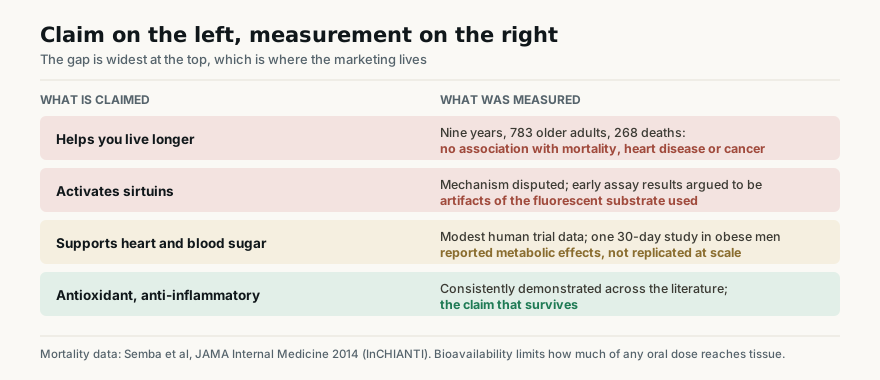
Every resveratrol supplement is sold on a lifespan story, yet when researchers followed 783 older adults for 9 years (per the 2014 InCHIANTI study), dietary resveratrol showed no link to death, heart disease or cancer. What the compound does do is more modest.

The short version
Resveratrol is the compound that started this industry, and its lifespan claim was finally checked in older adults followed for 9 years (per the 2014 InCHIANTI study). Red wine, the French paradox, sirtuins, a pharmaceutical acquisition worth hundreds of millions: every resveratrol supplement on sale today is downstream of that story.
It is also, unusually for this field, a compound that has been tested properly. Human trials have been run, and a large observational study measured real dietary exposure against death.
- Mortality: a cohort study in older Italian adults found no association with death.
- Mouse lifespan: the field's most rigorous testing program found no benefit.
- Mechanism: the sirtuin story that launched it is contested.
Anyone shopping for the best resveratrol supplement should know what those tests found before comparing labels, which is the reason for this page.
| Product | Evidence | Typical dose | 3rd-party tested | Best for | Not for | Price band |
|---|---|---|---|---|---|---|
| Trans-resveratrol, standard oral | Early / mixed evidence | 150 to 500 mg daily in most studies | Not stated | an inexpensive polyphenol with modest metabolic data | a longevity claim; the mortality data does not support it | $ · budget |
| High-dose resveratrol (1,000 mg and above) | Limited evidence | 1,000 mg or more per serving on sale | Not stated | nothing the evidence distinguishes | anyone who would rather avoid nausea, cramps and diarrhea | $$ · mid |
| Enhanced-absorption or hydrogel formats | Limited evidence | varies; premium priced | Not stated | addressing a genuine bioavailability problem | a trial-supported outcome advantage over standard capsules | $$$ · premium |
| Resveratrol from red wine | Limited evidence | far below any studied dose | Not stated | enjoying wine | a supplementation strategy; the alcohol carries its own risks | varies |
Affiliate links. We may earn a commission; it does not change our assessments.
What resveratrol is
Resveratrol is a polyphenol produced by plants in response to injury, ultraviolet light and fungal attack.[1] It appears in red grape skins, berries and peanuts, and reaches supplements mostly via extraction from Japanese knotweed rather than from grapes.
Its scientific interest came from the proposal that it activates sirtuins, a family of enzymes linked to nutrient sensing and, in some models, to lifespan. That places it conceptually alongside the other hallmarks-of-aging targets, which is how it acquired a longevity story before it had longevity evidence.[2]
The study that tested the actual claim
Most supplement compounds have never had their headline claim tested against a hard endpoint. Resveratrol has.
Who InCHIANTI followed
Researchers measured urinary resveratrol metabolites in older community-dwelling Italian adults, in a region where dietary resveratrol exposure is genuinely high, and followed them for nine years. Among 783 participants, 268 died.[3]
No link to death, heart disease or cancer
Limited evidence There was no association between resveratrol levels and all-cause mortality, none with cardiovascular disease and none with cancer. The people with the highest dietary resveratrol exposure did not fare better than those with the lowest.
Show the numbers as a table
| Measure | Value |
|---|---|
| Participants followed | 783 adults |
| Deaths over follow-up | 268 deaths |
What a 9-year cohort means for the resveratrol supplement pitch
The red-wine story predicts that people eating the most resveratrol should live longer and suffer less heart disease. InCHIANTI checked that in adults aged 65 and over, measuring 24-hour urinary metabolites rather than trusting food questionnaires, and found no link with inflammation markers either.[3]
For a buyer, this removes the strongest reason people give for taking the compound. It does not prove a high-dose capsule is useless, because diet delivers far less. It does mean the lifespan claim on the bottle rests on animals and cells, not on older humans.
- What this does not say
- Observational, dietary exposure levels far below supplement doses; it cannot rule out an effect of high-dose capsules.
That is not a supplement trial and it does not settle everything. Dietary exposure is lower than supplement doses, and an observational study cannot rule out an effect at higher intake. But it is the most direct test anyone has run of the claim the category is sold on, and it came back empty.
The mouse lifespan result
The mouse evidence points the same way. The compound was among those the NIA Interventions Testing Program evaluated without finding a lifespan benefit, in the same program whose positive results the supplement industry quotes freely.[4]
The net effect of resveratrol is a 0% effect on lifespan.
What are the benefits of taking resveratrol?
Stripped of the longevity framing, there is a real if modest evidence base: anti-inflammatory and antioxidant activity are consistently demonstrated, while human trial data cluster on cardiovascular measures, glycemic control and lipid metabolism.[5] [6] Each claim is taken in turn in our resveratrol benefits breakdown.
The 30-day metabolic trial
The most interesting single trial gave obese men 30 days of resveratrol (per Timmers 2011) and reported calorie-restriction-like effects on energy metabolism and metabolic profile.[7] It is one month, in one specific population, on metabolic markers rather than outcomes, and it has not been built into anything larger in the years since.
The bioavailability problem
Resveratrol is absorbed reasonably well and then metabolized almost immediately, so the amount of free compound circulating is small and short-lived. A 500 mg capsule does not produce anything close to 500 mg worth of exposure at the tissues.
Why lab doses do not translate
This matters for reading everything else:
- Cell studies use concentrations that oral dosing cannot achieve in a person.
- Animal doses scaled to human weight land far above what supplements provide.
When laboratory results do not reproduce in people, this is the leading explanation, and it is why premium formats advertise enhanced absorption. Whether solving the absorption problem produces a benefit is untested, because nobody has run that comparison on an outcome.
The mechanism that did not hold
The sirtuin activation story was the theoretical engine of the whole resveratrol phenomenon. It was also disputed, with arguments that some early assay results reflected the fluorescent substrate used rather than genuine enzyme activation. Sirtuins depend on NAD+, the same pathway behind the precursor pitch in our NAD booster review.
Why a contested mechanism still sells
The mechanism is not settled either way. What matters commercially is that a contested mechanism plus null mortality data plus a negative mouse lifespan result is a coherent picture, and the picture is not the one on the label. Supplements are still sold with sirtuin language as though the question were closed.
Take the fluorophore off, and resveratrol does absolutely nothing to this chemical reaction.
How much resveratrol should I take?
Human studies have most often used 150 mg to 500 mg a day. A resveratrol supplement on sale today runs from 100 mg to 1,800 mg per serving, and the high end is a marketing position rather than an evidence-based one.
Side effects at high doses
Above roughly 1,000 mg a day, nausea, stomach cramps and diarrhea become common. Toxicity is low overall and the compound is reasonably tolerated even at gram-level doses, but tolerated and useful are different things.[8] Our guide to where the resveratrol dose numbers came from traces each range back to the study that produced it.
What should you not mix with resveratrol?
Anticoagulants and antiplatelet drugs are the main concern, since resveratrol can affect platelet function and the combination raises bleeding risk. It also inhibits certain drug-metabolizing enzymes, which can alter how other medications are cleared from the body.[9]
A pharmacist with your medication list can resolve this in minutes; no article can.
Who cannot take resveratrol?
- Anyone on blood thinners or with a bleeding disorder.
- Anyone facing surgery, who should stop well in advance.
- Anyone pregnant or breastfeeding.
- Anyone with a hormone-sensitive condition, because resveratrol has weak estrogenic activity.
- Anyone in cancer treatment, who should raise it with their oncology team rather than deciding from a supplement label.
For most other people the compound is low-risk. Low risk and low benefit is the honest characterization, and at this price point that is not an unreasonable place to land.
Does resveratrol from red wine do anything?
The French paradox, the observation that French populations had lower heart disease than their saturated fat intake predicted, is where this all began. Resveratrol in red wine was one proposed explanation among several, and it was the one that got commercialized.
Why wine cannot deliver a studied dose
Wine contains far less resveratrol than any studied supplement dose, and the alcohol carries risks that are well established rather than hypothetical. The mortality study above is particularly pointed here, because it was conducted in Chianti, among people whose dietary resveratrol exposure was as high as it realistically gets.
Should I take resveratrol at all?
It depends what you are buying. As an inexpensive polyphenol with modest anti-inflammatory and metabolic data, it is a defensible low-cost choice, and its safety profile is reassuring for most people not on anticoagulants.
As a longevity compound, it has had a fairer test than almost anything else in this field and has not passed. Where that leaves it against the alternatives is set out in our guide to ranking longevity supplements by evidence. Fisetin and quercetin, the polyphenols now tested as senolytics, are reviewed in our senolytics guide.
How to read a resveratrol label without being sold to
- Trans-resveratrol, with its percentage. The active isomer, named specifically, not just resveratrol complex.
- Milligrams per serving. With the serving size in capsules, so you can compare against the 150 to 500 mg study range.
- The source. Japanese knotweed for most products, grape extract for some.
- A certificate of analysis. Ask for it, as with anything in this market.
- What the claim rests on. Sirtuin language describes a contested mechanism, not a settled result.
Resveratrol is the cautionary tale the rest of this field should be read against. It had the best story, the biggest investment, a compelling mechanism and an epidemiological origin myth, and then people ran the studies.
What survived is a cheap polyphenol with modest anti-inflammatory and metabolic effects and a real interaction risk for anyone on blood thinners. That is a perfectly respectable thing to be. It is not what the bottle says.
Frequently asked questions
What are the benefits of taking resveratrol?
The best-supported effects are anti-inflammatory and antioxidant activity, with some human data on glycemic control and cardiovascular measures. Those are real if modest. The longevity claim that made the compound famous has not held up in humans.
Does resveratrol make you live longer?
No human evidence supports that. A nine-year study of older Italian adults measured urinary resveratrol metabolites and found no association with all-cause mortality, heart disease or cancer. The people getting the most resveratrol from their diet did not live longer.
What is the downside of resveratrol?
Poor bioavailability, so a large oral dose produces small and short-lived blood levels. Digestive side effects above about a gram a day, and interactions with blood thinners, sit alongside a longevity claim that a mortality study and the field's most rigorous mouse program both failed to support.
Who cannot take resveratrol?
Anyone on anticoagulants or antiplatelet medication, anyone with a bleeding disorder or facing surgery, anyone pregnant or breastfeeding, and anyone with a hormone-sensitive condition, since resveratrol has weak estrogenic activity. Cancer patients should ask their oncology team rather than a website.
Is it okay to take resveratrol every day?
Daily use at typical supplement doses appears well tolerated and it has a fairly low toxicity profile. The open question is not daily safety at 150 to 500 mg, it is whether daily use achieves anything, and on that the human evidence is weak.
What should you not mix with resveratrol?
Blood thinners such as warfarin and antiplatelet drugs are the main concern, because resveratrol can affect platelet function. It also inhibits certain drug-metabolizing enzymes, which can change how other medications are cleared. This is a pharmacist conversation, not an article conversation.
Is CoQ10 the same as resveratrol?
No. CoQ10 is a component of the mitochondrial electron transport chain. Resveratrol is a plant polyphenol with antioxidant and signaling activity. They are frequently sold together, which is a marketing decision rather than a demonstrated synergy.
Why did resveratrol fall out of favor?
The sirtuin activation mechanism that made it exciting turned out to be contested, human trials produced modest and inconsistent results, and the mortality data, when someone finally looked, showed nothing. The hype was built on animal and cell work that did not transfer.
How much resveratrol should I take?
Products range from 100 mg to well over 1,000 mg per serving. Human studies have most often used 150 mg to 500 mg. Above roughly 1,000 mg a day digestive side effects become common, and there is no outcome evidence justifying the higher end.
Is trans-resveratrol better than regular resveratrol?
Trans-resveratrol is the biologically active isomer, so a product specifying it and its percentage is being more precise than one that does not. That is a quality signal about the label rather than proof of a better outcome.
Does resveratrol from red wine do anything?
The quantities in wine are far below any studied supplement dose, and the alcohol carries its own well-established risks. The French paradox story that launched this whole category was an epidemiological puzzle, not a demonstration that the compound in wine was responsible.
What foods contain resveratrol?
Red grapes and their skins, blueberries and other berries, peanuts, and to a small degree cocoa. Dietary quantities are modest, which is precisely why the mortality study measuring real-world dietary exposure is such a useful piece of evidence.
Does resveratrol help with blood sugar?
This is one of the better-supported claims. A trial in obese men reported calorie-restriction-like effects on energy metabolism and metabolic profile after 30 days (per Timmers 2011). The effects were small, the trial was short, and the population was specific.
Is resveratrol worth taking with NMN?
That pairing comes from a specific researcher's public protocol rather than from a trial. No study has tested the combination on any human outcome. Buying two unproven compounds together does not produce one proven one.
Does resveratrol have side effects?
At ordinary doses it is well tolerated. Above about 1,000 mg a day, nausea, cramps and diarrhea become common. The more consequential risks are interactions rather than direct side effects, particularly with anticoagulants.
Is resveratrol a sirtuin activator?
That was the original claim and it became contested. Some of the early assay results were argued to be artifacts of the fluorescent substrate used. The mechanism is not settled, which matters because it was the entire theoretical basis for the longevity claim.
What should I look for on a resveratrol label?
Trans-resveratrol named specifically with its percentage, milligrams per serving with the serving size in capsules, the source such as Japanese knotweed, a certificate of analysis, and a cost per day you calculated yourself.
Should I take resveratrol at all?
If you want an inexpensive anti-inflammatory polyphenol with a modest human evidence base, it is a defensible low-cost choice. If you are buying it to live longer, the evidence does not support that and the compound has had a fair test.
References
8 sources, all link-checked; oldest check
- Resveratrol levels and all-cause mortality in older community-dwelling adults. Semba RD et al. JAMA Internal Medicine 2014;174(7) (InCHIANTI; cited 234).Urinary resveratrol metabolites in older Italian adults over nine years, 268 deaths among 783 participants: no association with all-cause mortality, cardiovascular disease or cancer.Publisher blocks automated checks · last tried Sep 15, 2026
- Resveratrol: a double-edged sword in health benefits. Salehi B et al. 2018 (cited 1,355).The most-cited review of the compound; catalogues anti-inflammatory and antioxidant findings alongside the bioavailability and dose problems.Verified Sep 15, 2026
- Calorie restriction-like effects of 30 days of resveratrol supplementation on energy metabolism and metabolic profile in obese humans. Timmers S et al. Cell Metabolism 2011;14(5):612–622.Publisher blocks automated checks · last tried Sep 15, 2026
- Health benefits of resveratrol, and should you take it?. Cleveland Clinic Health Essentials, 25 January 2022.Mainstream clinical overview; notes low toxicity and reasonable tolerability up to high gram doses.Verified Sep 15, 2026
- Resveratrol, About Herbs monograph. Memorial Sloan Kettering Cancer Center, 17 February 2023.Cancer-center monograph covering claimed uses, interactions and cautions.Verified Sep 15, 2026
- Resveratrol: evidence summary (bioavailability & outcomes). Examine.com.Publisher blocks automated checks · last tried Sep 15, 2026
- Astaxanthin and meclizine extend lifespan in UM-HET3 male mice; fisetin, SG1002, dimethyl fumarate and mycophenolic acid do not. Harrison DE et al. GeroScience 2023 (NIA Interventions Testing Program; cited 64).The most rigorous multi-site mouse lifespan program tested fisetin and found no lifespan extension.Verified Sep 15, 2026
- Hallmarks of aging: an expanding universe. López-Otín C et al. Cell 2023;186(2):243–278.Updated framework: twelve hallmarks.Publisher blocks automated checks · last tried Sep 15, 2026
Every link above is re-requested on a schedule by an automated checker; the date shown is when it last answered. Publishers that block automated requests are marked as such rather than reported broken. Our editorial standards explain how a source gets cited here in the first place.
Filed by the Rapamycin.store evidence desk. Each source is re-checked when the page is reviewed.
Own a longevity or health brand?
Rapamycin.store publishes sponsored and guest posts on an aged, topically-relevant domain, and offers display advertising. Tell us what you want to promote and we'll send our current options.