The evidence guide
GLP-1 longevity: the strongest evidence, in the wrong population
The GLP-1 longevity case rests on a 20% cut in major cardiac events over about 33 months (per the SELECT trial), better randomized outcome data than any longevity supplement has. Almost all of it comes from people who are sick, which is why it does not transfer to the healthy person asking.

The GLP-1 longevity case, in short
A drug class built for diabetes and obesity cut major cardiac events by 20% over about 33 months in its largest outcome trial. That makes the GLP-1 longevity question the most serious one in this field, and the evidence arrived almost by accident, in trials designed to answer a different question.
A Nature Biotechnology editorial asked directly whether GLP-1s are the first longevity drugs.[1] The question is serious and the answer is complicated, mostly because of who was in the trials.
What GLP-1 drugs are, and how a diabetes drug entered this debate
GLP-1 is a hormone the gut releases after a meal, and it prompts insulin release when blood sugar is high, slows stomach emptying and signals fullness to the brain. The drugs in this class, semaglutide among them, mimic that hormone and last far longer than the natural version does.[2]
They were developed for type 2 diabetes, then for weight management, and the aging question arrived last. A healthspan review of the class argues that the effects on blood sugar, body weight, blood vessels and inflammation overlap with processes that drive age-related disease.[2]
Is GLP-1 the same as Ozempic?
No. GLP-1 names the hormone and the drug class; Ozempic is one brand of semaglutide, which is one drug within that class. Wegovy is the same molecule marketed for weight management, and SELECT tested semaglutide at the weekly dose used for that indication.[3]
| Name | What it refers to |
|---|---|
| GLP-1 | The gut hormone, and the drug class that mimics it |
| Semaglutide | One drug within the class |
| Ozempic | A brand of semaglutide |
| Wegovy | Semaglutide marketed for weight management |
The distinction matters for headlines. A result for semaglutide at a therapeutic dose in a defined population does not automatically extend to every drug in the class, every dose, or every person. The same molecule can also be sold under different names for different indications, which is why the name on a pen matters less than what is in it.
What the cardiovascular trial actually showed
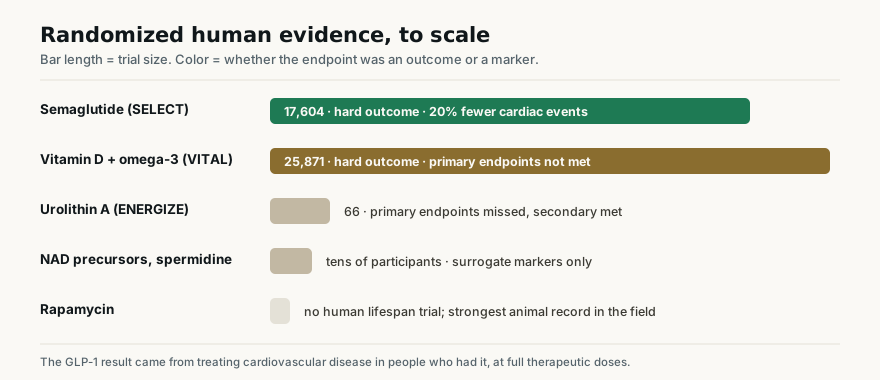
SELECT randomized 17,604 adults with overweight or obesity and established cardiovascular disease, but without diabetes, to weekly semaglutide or placebo. Over a mean exposure of roughly 33 months, semaglutide produced a 20% reduction in major adverse cardiovascular events.[3]
Strong human evidence That is a randomized, placebo-controlled trial in seventeen thousand people over nearly three years, with a fifth fewer heart attacks, strokes and cardiovascular deaths. Cardiovascular disease is a leading cause of death, so reducing it at that scale is not a surrogate marker moving in a small trial. It is the thing itself.
Reading a 20% relative reduction
The 20% figure is relative: it compares the rate of events on semaglutide with the rate on placebo. It describes a real effect, and it does not mean one in five participants avoided a heart attack, because most people in either group had no event during the trial.[3]
In absolute terms, the primary endpoint occurred in 6.5% of participants on semaglutide and 8.0% on placebo (per Lincoff 2023). That gap of 1.5 percentage points matters at population scale, and it is a different picture from the one a bare 20% suggests.
What SELECT was built to measure
Its primary endpoint combined cardiovascular death, nonfatal heart attack and nonfatal stroke. The trial was designed to answer that cardiovascular question, and it was never built to measure lifespan, frailty or the pace of aging.
Reading it as a longevity trial borrows its rigor for a question it did not ask. That is not a criticism of SELECT, only of how its headline travels, and the same caution applies to every result that follows on this page.
Nothing else in the field has this
No supplement, and neither metformin nor rapamycin, has produced evidence of this class. That is the honest case for the framing, stated before the caveats.
It is also why the rest of this page spends so long on limits. A result this strong deserves to be read precisely, because its limits are where most online claims about these drugs go wrong.
The biological aging signal
Beyond the cardiovascular outcomes, there is a direct aging-biology result. A randomized, double-blind, placebo-controlled study reported semaglutide slowing biological aging across multiple epigenetic clocks, with the effect attributed partly to reduced chronic immune activation.[4]
Chronic low-grade inflammation is implicated in age-related decline, and the healthspan review of the class treats it as a route from these drugs to slower disease.[2] A drug that reduces it and moves methylation clocks in the right direction has a coherent mechanistic story to go with its outcome data, which is rare in this field.
Clocks are still surrogate measures
Epigenetic clocks remain surrogate measures. This is a supporting result, not a second independent proof. How much one clock reading can move by chance is set out in our biological age test review.
The measurement problem is concrete. In one reliability analysis, technical noise alone produced deviations of up to 9 years between replicate samples across six prominent epigenetic clocks, while principal-component versions agreed within about 1 year.[5]
Show the numbers as a table
| Measure | Value |
|---|---|
| Standard clocks, replicates | up to 9 years |
| Principal-component clocks | about 1 year |
A randomized, placebo-controlled design protects against much of that noise, because random measurement error falls on both arms alike. That is why the semaglutide clock result carries more weight than a consumer test, and still less than an outcome.
Is the longevity benefit just from weight loss?
Nobody can yet say, and the honest answer is that the trials were not built to separate the two. Weight loss itself lowers blood pressure, blood sugar and inflammation, so a drug that produces it would be expected to reduce cardiovascular events for that reason alone.
In SELECT, mean body weight fell by 9.39% on semaglutide against 0.88% on placebo over 104 weeks (per Lincoff 2023). The cardiovascular result therefore arrived alongside substantial weight loss and cannot be cleanly separated from it.
Hints of effects beyond weight
There are hints of effects beyond weight. The clock study attributed part of the result to reduced chronic immune activation, and the healthspan review of the class describes direct actions on blood vessels and inflammation.[4,2] Neither establishes that the benefit would survive in someone with no excess weight to lose.
Why the answer changes the decision
It also changes what a healthy person should expect from the clock result. A shift measured in people carrying excess weight and inflammation may shrink, or vanish, where there is little of either to reduce.
That question is not academic. If the benefit runs mainly through weight loss, a lean, metabolically healthy person has little to gain and a measurable amount of muscle to lose.
The problem with the population
Here the case narrows sharply. SELECT enrolled people with overweight or obesity and established cardiovascular disease, and the other major trials enrolled people with obesity or type 2 diabetes, so almost the entire evidence base concerns people with a metabolic or cardiovascular condition.[6]
If you are one of those people, the evidence applies to you and it is strong. If you are metabolically healthy and asking about GLP-1 drugs for longevity, there is essentially no data on people like you. The mechanism by which the drugs helped in SELECT was reducing risk that the participants had and you may not.
Why a correction is not an enhancement
This is the supplement industry's favorite error in reverse: a treatment that corrects a problem is not automatically an enhancement in someone without it. Reviews making the healthspan case for the class are careful about this distinction, and popular coverage frequently is not.[2]
The age gap matters most for the readers most drawn to a longevity drug. Muscle loss is already under way in later life, so a treatment that adds to it has the most to cost in exactly the group the trials left out.
GLP-1 microdosing has no evidence behind it
A practice has grown up of taking sub-therapeutic doses, far below what is prescribed for weight loss, on the theory that the anti-inflammatory and metabolic benefits arrive at low doses while the side effects and muscle loss do not.[7]
It is a reasonable-sounding hypothesis, and no trial has tested it at a clock, cardiovascular or any other endpoint. Every number in the outcome data above comes from full therapeutic dosing. Microdosing borrows the credibility of those trials while departing from the thing they tested.
Cheap compounded semaglutide lost its legal cover in 2025
Much microdosing runs on compounded copies sold through telehealth, and those copies existed because of a shortage. The FDA declared that shortage over in February 2025 and gave compounders only until April or May of that year before shortage grounds stopped protecting them.
For a reader, that means a low monthly price built on compounded semaglutide now needs a clinical reason beyond cost, and its contents are not checked the way an approved pen is.
- What this does not say:
- Compounding for an individual patient's documented clinical need remains possible, and FDA policy has been revised repeatedly; the statement describes enforcement intent, not individual prosecutions.
Compounding for an individual patient's documented clinical need remains possible, and FDA policy on these copies has been revised repeatedly. The statement describes enforcement intent, not individual prosecutions, so the practical point is about quality checks rather than legality alone.
The practice is also far more searched than the longevity question itself, which tells you it is running well ahead of the evidence.
What a personal microdosing experiment cannot tell you
People who microdose often track a clock test, a blood panel or how they feel. None of these can show whether the practice extends healthy life, and a clock with replicate noise of several years can produce an apparent improvement by chance; a normal-looking panel does not rule out harm either.[5]
A single before-and-after reading in one person also cannot separate a drug effect from chance, a change in diet or training, or the ordinary drift of a blood panel. The trials behind the outcome data used placebo groups for exactly that reason, and a personal experiment has none.
Show the numbers as a table
| When | Event | Detail |
|---|---|---|
| 2023 | SELECT outcome result | 20% fewer cardiac events |
| Feb 2025 | Shortage resolved | FDA declaration |
| Apr 2025 | Pharmacy grace ends | state-licensed compounders |
| May 2025 | Outsourcer grace ends | outsourcing facilities |
| Jun 2026 | Clock study reported | semaglutide, placebo |
The muscle problem, which matters more here than anywhere
Rapid weight loss costs lean mass along with fat, and GLP-1 drugs produce rapid weight loss. Reduced bone density is reported alongside it, and both raise frailty risk in older adults.[6]
For every two parts of fat that you lose, you lose one of muscle.
For a weight-loss indication this is a manageable trade; for a longevity indication it is close to a contradiction.
Why lean mass is the wrong thing to lose
Muscle mass and strength are among the best predictors of independence in later life, and creatine plus resistance training, the intervention pair with the deepest randomized evidence in healthy aging, exists precisely to protect them.[8]
Taking a drug speculatively for longevity that erodes the one thing that evidence is clearest about is a real tension. It is also addressable. Resistance training and adequate protein throughout treatment are the standard mitigation, and anyone on these drugs for any reason should be doing both.
Strength as the number worth watching
Weight is the number most people track on these drugs, and for aging it is the wrong one. Strength is the closer proxy for independence in later life, and grip strength in particular is a quick, repeatable measure of it that needs no laboratory.
Measuring grip or leg strength during treatment shows whether the drug is costing muscle, which a scale cannot. Where training is part of the plan, creatine with resistance training is the pairing with the deepest evidence for keeping lean mass.[8]
How GLP-1 compares with rapamycin and metformin
The three prescription candidates in this field have genuinely different evidence profiles, and ranking them depends entirely on which evidence you weight.
- Hard human outcomes: GLP-1 drugs, by a very wide margin, in a specific disease population.
- Animal lifespan: rapamycin, with the most replicated record in the field.
- Human safety database: metformin, with decades of use across millions of patients.
- Longevity indication: none of them. No regulator has approved any drug for aging.
| Candidate | Strongest human evidence | Animal lifespan | Main open problem |
|---|---|---|---|
| Semaglutide (GLP-1) | SELECT: 17,604 people, 20% fewer major cardiac events | Not the basis of the case | Evidence sits in people with disease; lean mass loss |
| Rapamycin | Small trials of immune and safety markers | Consistent across a 167-study vertebrate meta-analysis | No outcome trial in healthy adults |
| Metformin | Decades of diabetes use; TAME has published no efficacy results | Not consistent in the same meta-analysis | Did not extend lifespan consistently in a vertebrate meta-analysis |
Where rapamycin stands
A meta-analysis pooling 167 studies across vertebrate species found that dietary restriction and rapamycin extended lifespan consistently.[9] Metformin did not show that consistency, which makes rapamycin the strongest animal lifespan signal among the three candidates here.
In people, the rapamycin evidence consists of small trials measuring immune function, safety and markers rather than lifespan or cardiovascular events. That is the gap GLP-1 drugs do not have, and our rapamycin guide sets out those trials one by one.
Where metformin stands
The same vertebrate meta-analysis found that metformin did not extend lifespan consistently.[9] Its human case rests largely on observational comparisons of people with diabetes, which cannot separate the drug from the differences between those who take it and those who do not. Our guide explains why the metformin case has weakened.
TAME, the trial designed to test whether metformin delays age-related disease, has published no efficacy results as of 2026.[10] So the oldest prescription candidate still has no randomized aging result, while the newest already has a hard cardiovascular one.
Who should not take a GLP-1 drug?
- Anyone with a personal or family history of medullary thyroid carcinoma or multiple endocrine neoplasia type 2, a class contraindication.
- Anyone with a history of pancreatitis, without specialist input.
- Anyone pregnant or planning pregnancy.
- Anyone with significant gastroparesis or severe gastrointestinal disease.
What can be inside a pen bought online
The risk of skipping a pharmacy is not only a missed benefit. Hospital clinicians in Italy treated a woman in a hypoglycemic coma after she injected a pen sold online as semaglutide; testing showed the vial held insulin. A second 2026 report describes a teenager hospitalized with ketoacidosis ten days after starting unsupervised online semaglutide.
The realistic failure
If a longevity experiment means sourcing the drug outside a prescription, the realistic failure is an emergency admission, not a result that simply fails to arrive.
If you use a GLP-1 drug, fill it only through a US-licensed pharmacy and confirm that pharmacy at safe.pharmacy (NABP) before paying.
- What this does not say
- Two single-patient case reports; they show what can be in an online pen, not how often it happens. Neither involves a pharmacy-dispensed or legitimately compounded product.
Gallbladder disease and pancreatitis are the monitored risks in ordinary use. These are prescription decisions made with someone who knows your history, and the growth of compounded and grey-market supply is exactly the wrong way to approach a drug with a contraindication list of this kind.
How often people stopped
In SELECT, adverse events led 16.6% of participants on semaglutide to stop treatment, against 8.2% on placebo (per Lincoff 2023), with gastrointestinal effects the most common reason. For a drug taken speculatively and indefinitely, tolerability is part of the evidence, not a footnote.
Discontinuation also shapes what the benefit means in practice. A treatment that roughly one in six people stopped because of side effects is harder to sustain for years than a trial summary suggests.
What the case reports do and do not show
| Patient | What was used | What happened |
|---|---|---|
| Woman, 31, Italy | A pen sold online as semaglutide that held insulin | Hypoglycemic coma, treated in hospital |
| Non-diabetic 18-year-old | Online semaglutide, escalated without supervision | Ketoacidosis ten days in; recovery over 36 hours |
The second report concerns a non-diabetic 18-year-old who escalated online semaglutide alone, arrived with a blood pH of 7.24, and recovered over 36 hours. The first involved a 31-year-old woman whose pen held insulin.
These are two single-patient reports. They show what can be inside an online pen and what unsupervised escalation can do, not how often it happens, and neither involves a pharmacy-dispensed or legitimately compounded product.
What would settle the question
A randomized, placebo-controlled trial in metabolically healthy adults, long enough to measure function, with lean mass and bone density tracked alongside any clock or cardiovascular marker. That is the design the current evidence lacks, and no such trial has reported.
| Design element | Current evidence | What would settle it |
|---|---|---|
| Population | Obesity, diabetes or established cardiovascular disease | Adults without any of the three |
| Endpoints | Cardiac events; epigenetic clocks | Strength, mobility, frailty or hard outcomes |
| Dose | Full therapeutic dosing | Arms including the low doses microdosers use |
| Safety | Lean mass and bone loss reported | Muscle and bone measured throughout |
Clocks alone would not be enough. With replicate noise of several years in standard versions, a clock endpoint needs both a placebo arm and a functional outcome beside it before a healthy person could act on the result.
The metformin precedent is a caution about timelines. A trial proposed years ago to test a cheap drug against aging has still published no efficacy results, so a definitive answer for GLP-1 drugs in healthy people is unlikely to arrive soon.[10]
Are the longevity claims coming from the drug companies?
Partly: the Nature Biotechnology editorial that framed the question followed presentations by Novo Nordisk and Eli Lilly at the Aging Research and Drug Discovery meeting.[1] The main healthspan review of the class lists authors with industry affiliations.[2]
Industry involvement does not make a finding wrong. SELECT is a large randomized trial published in a leading journal, and its result stands on its design. It does mean the longevity framing has commercial momentum, so each claim is worth checking against three things.
- Check the population: who was enrolled, and whether that includes you.
- Check the dose: whether the claim is about the dose actually tested.
- Check the endpoint: an event, a function, or a marker.
Should you take a GLP-1 drug for longevity?
If you have an indication these drugs are approved for, the aging-relevant benefits are a genuine bonus on top of a treatment you would want anyway, and the evidence supporting that is the strongest in this entire field.
Without an approved indication
If you are metabolically healthy, the honest answer on GLP-1 longevity use is that nobody knows, the practice most people are actually engaged in has no trial behind it, and the known downside works against the best-evidenced target in healthy aging.
A randomized trial in healthy adults with a functional endpoint would change that answer, and none currently exists. Until one reports, the decision rests on judgment rather than data, and it belongs with a prescriber. For the supplements people weigh instead, see longevity supplements ranked by human evidence.
Questions worth taking to a prescriber
None of this replaces a conversation with someone who knows your history. These are the questions the evidence on this page suggests asking.
- Indication: is there a condition these drugs are approved to treat, or is this purely speculative?
- Muscle: how will strength and lean mass be tracked, not just weight?
- Supply: is the product an approved, pharmacy-dispensed one?
- Stopping: what side effects or results would end the experiment?
- Monitoring: which blood tests and check-ins come with treatment, and how often?
- Afterward: what is expected to happen to weight and muscle if treatment stops?
Read the whole sentence
The GLP-1 longevity achievement is real: a large randomized reduction in a hard outcome that kills people. It also came from treating disease, in people who had it, at full therapeutic doses, with a documented cost in lean mass. Read the whole sentence, not the first half.
Frequently asked questions
Should you take GLP-1 for longevity?
If you have obesity, type 2 diabetes or established cardiovascular disease, the hard-outcome evidence is stronger than for anything else discussed as a longevity drug. If you are metabolically healthy, there is essentially no data on you, and the muscle and bone loss risks apply regardless.
Do GLP-1 drugs actually reduce deaths?
In the population studied, they reduce major adverse cardiovascular events. The SELECT trial randomized 17,604 adults with overweight or obesity and existing cardiovascular disease but no diabetes, and found a 20% reduction in major adverse cardiac events over a mean of about 33 months.
Why does that matter for longevity?
Because no supplement in this field has anything close to it. Cardiovascular disease is a leading cause of death, and a randomized reduction in cardiac events in 17,604 people is a different order of evidence from a marker moving in a trial of 30. That is the honest case for calling these longevity drugs.
Does GLP-1 slow biological aging?
A randomized double-blind placebo-controlled study reported semaglutide slowing biological aging across multiple epigenetic clocks, attributed partly to reduced chronic immune activation. Epigenetic clocks are surrogate measures, so this is a supporting signal rather than an outcome.
What is GLP-1 microdosing?
Taking sub-therapeutic doses, well below what is prescribed for weight loss or diabetes, on the theory that the metabolic and inflammatory benefits arrive at lower doses without the side effects. No trial has tested that theory at any endpoint. It is a widespread practice with no evidence base.
Does GLP-1 cause muscle loss?
Rapid weight loss of any kind costs lean mass, and GLP-1 drugs produce rapid weight loss. That is a serious consideration for healthy aging specifically, because muscle mass and strength are among the best predictors of independence in later life.
Why do people look older after GLP-1?
Facial fat loss. Subcutaneous fat is lost from the face along with everywhere else, which can read as aging even when metabolic health has improved. It is a cosmetic consequence of the weight loss rather than an effect on aging biology.
Can you stay on GLP-1 for life?
That is the working assumption in the field for people taking them for obesity, because stopping generally leads to weight regain and the return of the underlying metabolic risk. Long-term data is accumulating rather than complete, and indefinite use is a decision made with a prescriber.
Is two years too long to be on Ozempic?
No evidence establishes two years as a limit. These drugs are prescribed for chronic conditions on the expectation of continued use. The relevant questions are ongoing tolerability, whether lean mass is being protected, and whether the original indication still applies.
Does GLP-1 speed up aging?
Nothing suggests it accelerates biological aging, and the epigenetic clock data points the other way. The specific concerns that are real, lean muscle loss and reduced bone density, are worth taking seriously and are addressable with resistance training and adequate protein.
What organ is Ozempic hard on?
The main monitored concerns are pancreatitis, gallbladder disease and, at the class level, a thyroid C-cell tumor signal seen in rodents that drives a contraindication in people with a personal or family history of medullary thyroid carcinoma. These are prescriber conversations.
How do GLP-1 drugs compare with rapamycin or metformin for aging?
On human hard-outcome data, GLP-1s are ahead of both by a wide margin, though in a specific disease population. On animal lifespan data, rapamycin is ahead, and metformin has the weakest recent trajectory of the three. None has a longevity indication.
Is the longevity benefit just from weight loss?
Not entirely. Analyses of the cardiovascular trial data have reported benefit that appears at least partly independent of how much weight was lost, which points to inflammatory and vascular mechanisms rather than body mass alone. That question is still being worked out.
Who should not take a GLP-1 drug?
Anyone with a personal or family history of medullary thyroid carcinoma or MEN2, anyone with a history of pancreatitis without specialist input, anyone pregnant or planning pregnancy, and anyone with significant gastroparesis. Eligibility is a prescriber decision.
Can I take a GLP-1 drug just for anti-aging?
These are prescription medicines and no regulator has approved any of them for a longevity indication. A prescriber can consider whether you have an indication they are approved for. This site does not point anyone toward compounded or unregulated supply.
What should someone on a GLP-1 do to protect muscle?
Resistance training and adequate protein intake, consistently, throughout. This is the single most useful practical point on this page, because the intervention that protects against the drug's main aging-relevant downside is also the one with the best independent evidence for healthy aging.
Are the longevity claims coming from the drug companies?
Partly. The framing gained momentum after presentations by Novo Nordisk and Eli Lilly at an aging research meeting, which a Nature Biotechnology editorial covered directly. That does not make the data wrong, and it is context a reader should have.
What would settle the question?
A randomized trial in metabolically healthy adults with a functional or mortality endpoint. Nothing of that kind exists, which is why the honest summary is that GLP-1 drugs have the best hard-outcome data in the field, in people who are not the ones asking this question.
References
10 sources, all link-checked; oldest check
- Are GLP-1s the first longevity drugs?. Nature Biotechnology editorial, 12 November 2025.Editorial framing the question after Novo Nordisk and Eli Lilly presentations at the Aging Research and Drug Discovery meeting.Verified Sep 15, 2026
- Glucagon-like peptide-1 receptor agonists to expand the healthy lifespan: current and future potentials. Kreiner FF et al. 2023 (cited 33).Review of the healthspan case for the drug class; authors include industry affiliations.Verified Sep 15, 2026
- Semaglutide and cardiovascular outcomes in obesity without diabetes (SELECT). Lincoff AM et al. New England Journal of Medicine 2023;389:2221–2232.Publisher blocks automated checks · last tried Sep 15, 2026
- Study: popular GLP-1 drug may slow down biological aging. UC San Diego Today, 2 June 2026.Reports semaglutide slowing biological aging across multiple epigenetic clocks in a randomized double-blind placebo-controlled study, attributed to reduced chronic immune activation.Verified Sep 15, 2026
- A computational solution for bolstering reliability of epigenetic clocks: implications for clinical trials and longitudinal tracking. Higgins-Chen AT et al. Nature Aging 2022;2:644-661.Technical noise produced deviations of up to 9 years between replicate samples across six prominent epigenetic clocks; principal-component versions agreed within about 1 year.Verified Sep 15, 2026
- Are weight-loss drugs also longevity drugs?. The New York Times, 29 June 2026.Mainstream assessment; notes lean muscle and bone density loss and the absence of data in metabolically healthy people.Publisher blocks automated checks · last tried Sep 15, 2026
- GLP-1 microdosers are chasing longevity. Science News, 20 March 2026.Reporting on off-label sub-therapeutic dosing for healthy-aging purposes, a practice with no trial evidence behind it.Verified Sep 15, 2026
- International Society of Sports Nutrition position stand: safety and efficacy of creatine supplementation. Kreider RB et al. Journal of the International Society of Sports Nutrition 2017;14:18.Verified Sep 15, 2026
- Rapamycin, not metformin, mirrors dietary restriction-driven lifespan extension in vertebrates. Ivimey-Cook ER et al. Aging Cell 2025;e70131 (cited 10).Meta-analysis pooling 167 studies across vertebrate species; dietary restriction and rapamycin extended lifespan consistently, metformin did not.Publisher blocks automated checks · last tried Sep 15, 2026
- TAME: Targeting Aging with Metformin. American Federation for Aging Research.The proposed multi-center trial designed to test whether metformin delays age-related disease; as of 2026 it has published no efficacy results.Publisher blocks automated checks · last tried Sep 15, 2026
Every link above is re-requested on a schedule by an automated checker; the date shown is when it last answered. Publishers that block automated requests are marked as such rather than reported broken. Our editorial standards explain how a source gets cited here in the first place.
Filed by the Rapamycin.store evidence desk. Each source is re-checked when the page is reviewed.
Own a longevity or health brand?
Rapamycin.store publishes sponsored and guest posts on an aged, topically-relevant domain, and offers display advertising. Tell us what you want to promote and we'll send our current options.