Work with us
Write for us & sponsored posts
Write for us on one condition: your claims meet a standard under which only 18% of the compounds we grade reach strong human evidence (3 of 17, per our evidence table).
Send a guest post inquiry
Write for us: what this publisher accepts
Only 18% of the compounds we grade reach strong human evidence (per our evidence table), and contributed articles are read against that same bar. We publish sponsored and guest content, always disclosed, but no commercial relationship decides an evidence grade.
| Format | What it is | How it is labeled |
|---|---|---|
| Guest post | A full article on a longevity or healthspan topic | Guest content, above the headline |
| Sponsored post | A paid article under the same sourcing rules | Sponsored, above the headline |
| Display placement | An ad space separate from editorial content | Clearly marked as an ad |
Guest posts
Write for us with a full article on a longevity or healthspan topic, written to our editorial guidelines and labeled as guest content. Our flagship evidence review shows the depth we expect.
Sponsored posts
A paid article, labeled as sponsored above the headline, held to exactly the same sourcing rules.
A sponsored post is edited like any other article: each claim is checked against its source, the evidence tier is stated and marketing vocabulary comes out.
Display placements
Clearly marked ad placements, available as traffic qualifies. The advertise page covers display and affiliate partnerships.
Why contributors choose an evidence-first health publisher
A placement is worth what the reader's trust is worth. Our readers come for cited, plain-language science, and they stay because a page tells them when the human data is thin. A sponsored post that sits inside that context borrows its credibility; one that breaks it spends everyone's.
That context is also why a placement here reads differently from a directory listing. Readers arrive from a guide that has already told them which claims hold up, so a contributed article is judged against the same page they just trusted.
Who this publisher is not for
If you want to write for us because a health guest post elsewhere would carry fewer checks, look elsewhere. The checks are the product.
The evidence standards every contributor meets
Every health claim needs a citation to primary literature, meaning peer-reviewed studies found via PubMed or a DOI, or to a reputable secondary source such as a government health body. Claims are then weighed in a fixed order.
What counts as evidence in a guest post?
- Human randomized controlled trials.
- Observational human studies.
- Animal or cell studies, always labeled as such.
That order follows the GRADE approach (Guyatt et al. 2008, BMJ), where randomized trials start as high-quality evidence and observational studies start low. A body of evidence then moves down a level for any of these problems:
- Limitations in how the studies were run.
- Inconsistent results between studies.
- Indirectness, such as a different population, dose or outcome than the claim describes.
- Imprecision, meaning too few participants or events to be sure.
- Likely publication bias.
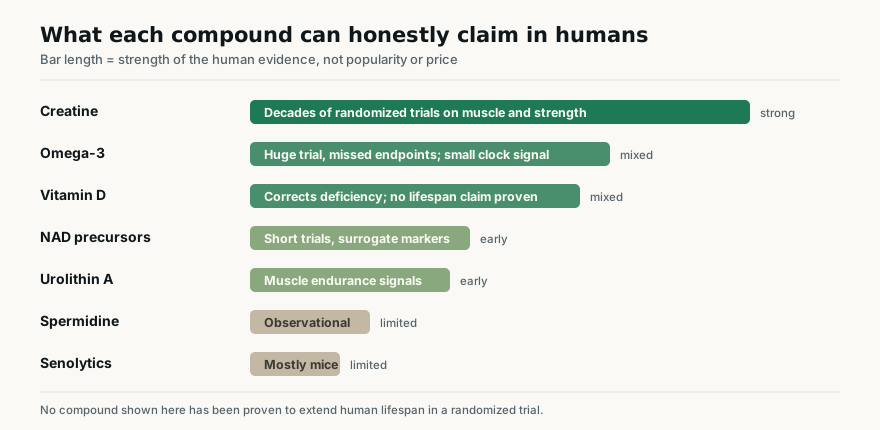
Our compound and product pages carry an evidence badge graded strong, early or mixed, or limited. The chart below shows how few compounds clear the top grade under that rubric, which is the bar a contributor's claims are read against.
Show the numbers as a table
| Measure | Value |
|---|---|
| Strong human evidence | 3 compounds |
| Early or mixed evidence | 7 compounds |
| Limited evidence | 7 compounds |
Before a trial counts toward a grade, we read it for risk of bias using the domains in the Cochrane Handbook: how participants were randomized, deviations from the assigned intervention, missing outcome data, how the outcome was measured, and whether the reported result was selected from several.
How conflicts of interest are handled
If a trial you cite was funded by the company selling the product, say so; we do the same on our own pages. The full rubric sits on our editorial standards page.
We follow the International Committee of Medical Journal Editors on both disclosure and authorship. A byline belongs to someone who contributed substantially to the work, drafted or critically revised it, approved the final version and agrees to be accountable for its accuracy.
Why a sponsored post inherits the duty to prove its claims
US regulators treat a paid article on a health site as advertising. Under FTC guidance, a health claim in sponsored or affiliate content needs competent and reliable scientific evidence behind it, and any material connection, such as payment or a commission, has to be disclosed clearly.
What happens when a claim fails the evidence check
For you, that means a claim we could not defend on our own page cannot run under your byline either. It is also why we ask for the studies before we quote any rate: the evidence check comes first, not after the invoice arrives.
- What this does not say:
- FTC guidance explains enforcement policy; outcomes depend on the specific claim and context.
The FTC's Health Products Compliance Guidance spells out what that evidence usually looks like, and it is the checklist we read a sponsored claim against:
- High-quality randomized, controlled human trials, not animal or test-tube work alone.
- Trials of the product itself, or of an essentially equivalent formulation and dose.
- Results that are statistically significant and also meaningful to a person.
- A claim that fits the totality of the evidence, not a single favorable study.
What we reject
To keep the site trustworthy, which is what makes a placement worth anything, some content is declined whatever the fee.
What gets a pitch rejected?
- Promotion of prescription-drug sales, grey-market pharmacies, or offers that skip a prescription.
- Unsupported health claims, or animal results presented as if they were human results.
- Personalized medical advice, a diagnosis, or a recommended personal dose.
- Topics that have nothing to do with longevity or healthspan.
- Marketing vocabulary that promises a result or a certainty the evidence cannot give.
Declining a pitch is rarely about the subject. The topics that fit are the ones our own hubs already cover, and a strong article on any of them is welcome:
- Rapamycin, metformin and GLP-1 drugs, written as evidence reviews rather than buying guides.
- NAD+ precursors such as NMN and NR, resveratrol, urolithin A and spermidine.
- Senolytics, autophagy and cellular senescence.
- Biological age tests, epigenetic clocks and what they can and cannot measure.
Link and disclosure policy
Disclosure is not negotiable. Our affiliate disclosure describes the rules every commercial link on the site follows, including links inside guest content.
| Link type | Earns or paid? | Link attribute | Allowed? |
|---|---|---|---|
| Study, regulator or trial registry | Never | Standard citation link | Yes, to the PubMed record or DOI |
| Paid placement or affiliate product | Yes | rel="sponsored", disclosed near the claim | Yes, if the product survives review |
| Brand summary of a study | Varies | Not used | No, link the study itself |
| Grey-market seller or no-prescription pharmacy | Any commission | Not used | Never, under any arrangement |
Are links in a guest post marked sponsored?
Yes. Sponsored and guest articles say so above the headline, and outbound links that earn money, or were paid for, carry rel="sponsored" in the page code.
Placement matters as much as wording. FTC endorsement guidance expects a disclosure to be clear, conspicuous and close to the claim, so a label hidden behind a link or at the foot of the page does not count.
Which links are cited on their merits?
Links to studies, regulators and trial registries never earn anything. We link to the PubMed record or the DOI, not to a brand's own summary of the study.
Which destinations are never linked?
Grey-market sources and unprescribed drug sellers, under any arrangement. That includes pharmacies that ship without a prescription, whatever the commission on offer.
Buying a placement does not buy a favorable evidence assessment. If a link in any article is not disclosed the way this policy describes, we treat it as a correction and fix it first.
How a submission moves from pitch to page
The process is short on steps and long on checking. Each stage below is one we run on every sponsored post and guest article; we do not publish fixed durations for them.
Show the numbers as a table
| When | Event | Detail |
|---|---|---|
| Step 1 | Send claims | with links to studies |
| Step 2 | Evidence check | against our rubric |
| Step 3 | Options and rates | or a clear no |
| Step 4 | Edit | accuracy and house style |
| Step 5 | Publish | labeled above headline |
At the evidence check we open every cited study, confirm it tests what the claim says, and place it on the rubric. A claim resting on a mouse result, or on a trial of a different dose or form than the product, goes back with a note rather than a rate.
Display advertising
Banner and sponsorship placements are handled separately from editorial content, and the same three exclusions apply: prescription-drug sales, grey-market sources and unsupported health claims.
Affiliate partnerships
Affiliate partnerships are open to supplement brands whose products survive an honest evidence review.
An affiliate link is disclosed on the page where it appears, under the same rules as a sponsored post, and a commission never moves a product up an evidence ranking.
Rates and what to send
Rates are quoted on request, because they depend on the format you want. Anyone who wants to write for us starts the same way, and we reply with current options and rates, or with a clear no.
How are rates for a sponsored post set?
- The product or service, and the exact claims your own marketing and packaging make for it.
- The human evidence behind those claims, with direct links to the published studies.
- Whether you want a sponsored post, a guest article, display space or an affiliate arrangement, or are unsure.
- For a supplement, any independent purity or dose testing, with the laboratory's name and the certificate date.
Questions contributors and advertisers ask
How much does a sponsored post cost?
Rates are quoted on request. They depend on the placement type, whether that is a sponsored article, a guest article or display space, so we do not publish a price list. Send the details through the form and we reply with current options and rates, or with a clear no.
Do you accept guest posts on health topics?
Yes, on longevity and healthspan topics that fit an evidence-first health publisher. A health guest post is held to the same editorial standards as our own pages: primary-source citations for every health claim, the evidence tier named, and no personal dosing advice.
Will my sponsored post be labeled?
Yes. Paid placements are labeled as sponsored, and sponsored and guest articles say so above the headline, not in a footer or a tooltip. There is no unlabeled option, because disclosure of a material connection is what US endorsement guidance expects.
What kind of content do you reject?
Anything that promotes prescription-drug sales, grey-market pharmacies or offers that skip a prescription; anything making unsupported health claims; and anything off-topic for a longevity reader. We also decline copy built on promise words, because they signal selling rather than evidence.
Are outbound links in a guest post dofollow?
Outbound links that earn money, or that were paid for, are marked rel="sponsored" in the page code. Links to studies, regulators and trial registries carry no commercial relationship and are cited on their merits. We do not link to grey-market sources under any arrangement.
Does paying for a placement change your evidence grades?
No. Buying a placement does not buy a favorable evidence assessment. Commissions and sponsorships never decide which products we recommend or how we grade the evidence, and a product's grade on our own pages stays whatever the human data supports.
How long does it take to get a reply?
We do not publish a fixed turnaround. A complete first message, with your product, its exact claims and links to the studies behind them, is the fastest route, because it removes the round of questions that otherwise comes first.
Will you edit my article?
Yes, where it is needed. We edit for accuracy and house style, which includes checking each health claim against its cited source, stating the evidence tier, and removing marketing vocabulary. We may also decline a piece that cannot be edited to fit.
Can I promote a prescription drug or a telehealth prescriber?
No. We do not sell, earn commissions on or facilitate the purchase of prescription drugs, and that holds even where a telehealth service or a pharmacy would pay for the referral. Pages about prescription medicines explain the evidence and the prescribing route, and stop there.
What should my first message include?
The product or service and the exact claims its marketing makes; the human evidence behind those claims, with direct links to the published studies; the format you want; and, for a supplement, any independent purity or dose testing with the laboratory's name and the certificate date.
Sources behind these policies
6 sources, all link-checked; oldest check
- Recommendations for the Conduct, Reporting, Editing, and Publication of Scholarly Work in Medical Journals. International Committee of Medical Journal Editors, updated 2025.The conflict-of-interest and authorship conventions this desk follows for a lay publication.Verified Sep 15, 2026
- GRADE: an emerging consensus on rating quality of evidence and strength of recommendations. Guyatt GH et al. BMJ 2008;336:924.The framework behind the strong / mixed / limited evidence grades used across this site.Verified Sep 15, 2026
- Cochrane Handbook for Systematic Reviews of Interventions. Higgins JPT et al., version 6.5, 2024.Risk-of-bias methodology used when this desk appraises a trial.Verified Sep 15, 2026
- PubMed. US National Library of Medicine, National Institutes of Health.The index every citation on this site is checked against before publication.Verified Sep 15, 2026
- The FTC's Endorsement Guides: What People Are Asking. US Federal Trade Commission business guidance, on 16 CFR Part 255.The rule requiring clear and conspicuous disclosure of material connections, including affiliate commissions.Verified Sep 15, 2026
- Health Products Compliance Guidance. US Federal Trade Commission, December 2022.The substantiation standard for health claims in advertising: competent and reliable scientific evidence.Verified Sep 15, 2026
Every link above is re-requested on a schedule by an automated checker; the date shown is when it last answered. Publishers that block automated requests are marked as such rather than reported broken. Our editorial standards explain how a source gets cited here in the first place.
Filed by the Rapamycin.store evidence desk. Each source is re-checked when the page is reviewed.