The evidence guide
Urolithin A supplements: what the trials actually found
The urolithin A supplement case rests on one 4-month randomized trial in 66 older adults, and that trial missed both of its primary endpoints. It is still the best-designed of the newer longevity compounds.

The short version
Most of what you read about any urolithin A supplement traces back to a trial that lasted 4 months. It gave 1,000 mg a day to older adults and met secondary endpoints, not primary ones. One company funded that science and then built the market on it.
The science is real and better than most of what this field offers. It is also more equivocal than the packaging suggests, and the gap between those two statements is what this page is for.
| Product | Evidence | Typical dose | 3rd-party tested | Best for | Not for | Price band |
|---|---|---|---|---|---|---|
| Urolithin A, standard oral (branded) | Early / mixed evidence | 500 to 1,000 mg daily in trials | Not stated | the format the randomized trials actually used | anyone expecting the primary endpoints to have been met | $$$ · premium |
| Urolithin A, generic oral | Early / mixed evidence | 500 to 1,200 mg per serving on sale | Not stated | the same molecule at a lower cost per day | those who want the trialed product specifically | $$ · mid |
| Liposomal urolithin A | Limited evidence | varies widely | Not stated | a plausible absorption hypothesis | a trial-supported reason to pay the premium | $$$ · premium |
| Pomegranate or ellagitannin precursor complex | Limited evidence | quoted as total formula milligrams | Not stated | people who already convert ellagitannins well | the majority whose gut bacteria do not convert efficiently | $ · budget |
Affiliate links. We may earn a commission; it does not change our assessments.
What urolithin A actually is
Urolithin A is a postbiotic, which means it is not the thing you eat but the thing your gut bacteria make from what you eat. Ellagitannins in pomegranate, walnuts and some berries are the raw material.
The National Cancer Institute describes the supplement neutrally as a compound that may modulate mitochondrial activity with potential antioxidant and anti-inflammatory effects, which is a fair summary of where the evidence sits.[1]
The proposed mechanism: mitophagy
The proposed mechanism is mitophagy, the selective clearing of damaged mitochondria. Mitochondrial dysfunction and impaired recycling are recognized hallmarks of aging, which is what makes the compound scientifically interesting rather than merely commercial.[2] General autophagy, the broader recycling pathway, is the rationale sold behind spermidine supplements.
What the pivotal trial actually found
ENERGIZE was a double-blind, placebo-controlled randomized trial in 66 older adults, half taking 1,000 mg of urolithin A daily as four 250 mg softgels, over four months.[3] It had two pre-specified primary endpoints: change in six-minute walk distance, and change in maximal ATP production in hand muscle.
Both primary endpoints were missed
Early / mixed evidence Neither was met. Walking distance improved by 60.8 meters in the treated group against 42.5 meters on placebo, a difference that was not statistically significant. Maximal ATP production showed no significant treatment effect in hand or leg muscle.
The secondary endpoints that did move
The secondary endpoints tell a different story, and it is a genuinely positive one.
- Muscle endurance, measured as contractions before fatigue, improved significantly at two months in hand and leg muscles.
- Plasma acylcarnitines and ceramides fell.
- C-reactive protein, an inflammation marker, fell in the treated group and not on placebo.
- Safety was clean, with no serious adverse events.
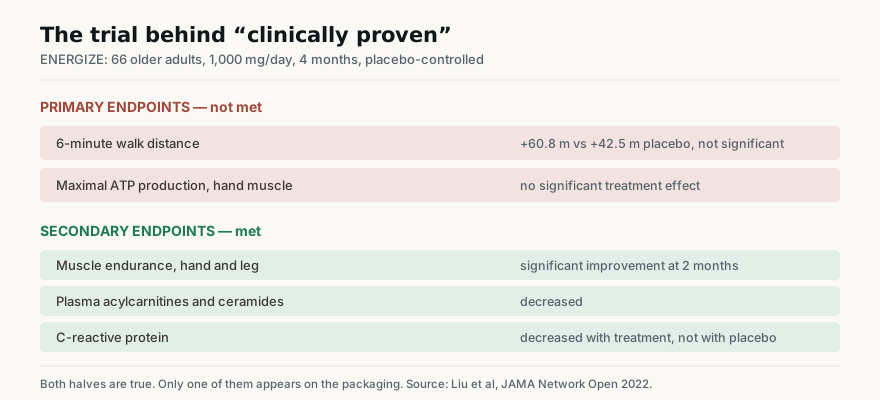
A trial that misses its primary endpoints has not demonstrated its hypothesis. A trial that moves several coherent secondary measures together has found something worth pursuing. Holding both at once is the honest position.
The outcomes on the box are the ones the trial did not move
Products in this category lead with energy and mobility. Those map onto exactly the two measures ENERGIZE set out to test, maximal ATP production and six-minute walk distance, and neither beat placebo over the 4 months of dosing.
What did improve, muscle endurance and some blood markers, was not the pre-specified test. For a buyer, that means paying for a plausible endurance signal, not a proven gain in energy or walking.
- What this does not say
- One trial, all White participants, 4 months; secondary findings may be real but were not the pre-specified test, and co-authors are employed by the company developing the compound.
Does urolithin A supplement work?
The claim best supported by the data is narrow: urolithin A appears to improve muscle endurance, meaning how long a muscle keeps contracting before it fatigues, in older adults, over months. It is not a strength claim and not a walking-speed claim, because those were measured and did not reach significance.
Show the numbers as a table
| Measure | Value |
|---|---|
| Urolithin A 1,000 mg | 60.8 m |
| Placebo | 42.5 m |
Who ran the earlier work
The earlier first-in-human work established safety and a molecular signature consistent with improved mitochondrial function, and it is worth noting that the authors were affiliated with the company commercializing the compound.[4] That is standard practice and not a scandal. It is context a reader is entitled to have when the same company's marketing says clinically proven.
The conversion problem nobody puts on the front of the box
You cannot eat urolithin A: you eat ellagitannins, and your gut bacteria may or may not convert them. Conversion capacity varies enormously between individuals, and a substantial share of people convert poorly or not at all.[5]
Why poor converters change the math
This is the compound's real commercial rationale, and it is a good one. If you are a poor converter, no amount of pomegranate juice reaches the doses used in trials.
It also has an implication the sellers of precursor complexes would rather you did not draw: a pomegranate extract product is betting on the same conversion step that the finished molecule exists to bypass.
What is the best form of urolithin A supplement?
The trials used ordinary oral urolithin A, the format with evidence attached to it. Liposomal versions argue better absorption, and no head-to-head trial has compared them on any outcome. Precursor complexes are cheaper and carry the conversion problem described above.
Liposomal and precursor formats
The practical hierarchy is therefore: the molecule at a trial-comparable dose beats a precursor complex, and no format beats another on evidence because nobody has run the comparison. Paying a premium for a delivery mechanism is buying a hypothesis, which is fine done knowingly.
Is urolithin A the same as CoQ10?
No, and the confusion is understandable because both are sold as mitochondrial support. CoQ10 is a component of the electron transport chain, involved in producing energy, while urolithin A is proposed to work upstream of that, by stimulating the removal of mitochondria that have stopped working well.
Different mechanisms, different literatures, and no trial has compared them. Taking both is common and is not supported by evidence that they combine usefully.
How much urolithin A should I take?
Human trials have used 500 mg and 1,000 mg a day, and ENERGIZE used 1,000 mg over four months. Products on sale reach 1,200 mg per serving and advertise the higher number as an advantage.
No dose-response relationship has been demonstrated in humans for any outcome, so the higher dose is more expensive rather than better. If you are matching a trial, 1,000 mg a day for at least two months is the protocol with data behind it. Our guide to what the trials actually dosed goes into the detail.
Do the cost arithmetic
This is one of the most expensive compounds in longevity supplementation, and the arithmetic is worth doing explicitly rather than absorbing as a monthly charge. Work out the price per day at the labeled serving, not per bottle, and put it next to what you would pay for a compound with stronger evidence.
Creatine as the comparison
Creatine, which has decades of randomized human trials for muscle and strength, costs a small fraction as much per day.[6] That comparison does not make urolithin A a bad purchase. It does make it a purchase you should make deliberately, and it is a comparison the category never invites.
Who should not take urolithin A?
Anyone pregnant or breastfeeding, anyone with an active cancer diagnosis without oncology input, and anyone on prescription medication who has not checked for interactions. In each case the trials excluded these groups, so there is no evidence base to reason from, and that absence is the reason for caution.
What the safety data shows
Safety data in the studied population has been reassuring. No serious adverse events were reported at 1,000 mg a day over four months, and no liver signal has emerged. Short trials in small groups cannot rule out rare or slow effects, which is a limitation rather than a warning.
Does urolithin A make you look younger?
Nothing in the trial record addresses appearance. The measured outcomes were walking distance, ATP production, muscle endurance and blood markers. Claims about skin or visible aging for this compound are extrapolation from the word mitochondria, not results.
If skin is the actual goal, the evidence base you want is a different one entirely, and we cover the compound with real dermatological trial data in our guide to what topical treatments have actually shown.
What clinically proven is doing on this label
Clinically proven is a marketing phrase with no regulatory definition for dietary supplements. It means a clinical trial exists. It does not mean the trial met its endpoints, and here it did not meet its primary ones.
The useful habit is to treat the phrase as a prompt rather than a conclusion: proven of what, in whom, over how long, and did the study hit the target it set itself before it started. Applied to this compound, the answers are respectable and specific, which is more than most of this category can say.
How to read a urolithin A label without being sold to
- Urolithin A named as the molecule. Not pomegranate extract, not an ellagitannin complex, unless you specifically want the precursor and understand the conversion issue.
- Milligrams per serving. With the serving size stated in capsules or softgels, so you can compare with the 1,000 mg trial protocol.
- A batch certificate of analysis. Ask. The reply tells you as much as the document.
- Cost per day at the labeled serving. Calculated by you, before purchase.
- What the claim rests on. If a page says clinically proven, look for which endpoint.
Running your own trial of it
Pick a measure connected to endurance rather than maximum strength, because endurance is what the trial data supports. Give it at least three months, since the signal in ENERGIZE appeared at two. Change one thing at a time, and decide the stopping rule before you start.
If you want an objective baseline rather than an impression, see our guide to measuring whether anything changed and what those tests can and cannot tell you.
The bottom line
Urolithin A deserves more respect than the average longevity compound and less certainty than its marketing conveys. It has a real randomized trial in older adults, a coherent mechanism, a clean safety record and a modest finding on muscle endurance.
It also has two missed primary endpoints, a premium price, and a conversion story the precursor products quietly depend on. Buy it knowing all of that, or do not buy it; both are defensible.
Frequently asked questions
Does urolithin A really work for muscle strength?
The strongest claim the data supports is muscle endurance, meaning the number of contractions before fatigue, rather than maximum strength. In the ENERGIZE trial that endurance effect appeared at two months. Six-minute walk distance improved more in the treated group than placebo but not significantly.
Who should not take urolithin A?
Anyone pregnant or breastfeeding, anyone with an active cancer diagnosis without oncology input, and anyone on prescription medication who has not checked interactions. The trials excluded these groups, so the honest reason is absence of evidence rather than a known harm.
Is urolithin A hard on the liver?
No liver safety signal has emerged in the human trials, which reported no serious adverse events at 1,000 mg a day over four months. Those trials were small and short, so this is a statement about what has been looked for and not found.
Is urolithin A the same as CoQ10?
No, though both are marketed for mitochondrial health. CoQ10 participates in the electron transport chain, while urolithin A is proposed to stimulate mitophagy, the clearing of damaged mitochondria. They have different mechanisms, different evidence bases, and no head-to-head trial.
Does urolithin A make you look younger?
Nothing in the trial record supports a visible appearance claim. The measured outcomes were muscle endurance, walking distance, ATP production and blood markers. Skin and appearance claims for this compound run well ahead of what has been tested.
Why do pomegranate extracts not work the same way?
Urolithin A is not in pomegranate. It is produced when gut bacteria break down ellagitannins from pomegranate, walnuts and berries, and only a minority of people carry the microbiome to do that efficiently. That conversion gap is the entire commercial rationale for taking the finished molecule directly.
How much urolithin A should I take?
Human trials have used 500 mg and 1,000 mg a day. The ENERGIZE trial used 1,000 mg as four 250 mg softgels over four months. Products on sale go higher than that without any trial supporting the increase, so higher is more expensive rather than demonstrably better.
How long does urolithin A take to work?
In the trial data, the muscle endurance signal appeared at two months and the trial ran four. If you are testing it on yourself, anything under two months is too short to conclude much, and the plan should be set before you start.
Is Mitopure worth the price?
Mitopure is the most-studied branded form, and the trials behind it were run with company involvement, which is normal in this field and worth knowing. At roughly a hundred dollars a month it is one of the most expensive items in longevity supplementation. Whether that is worth a secondary-endpoint muscle endurance finding is a judgment, not a fact.
What does clinically proven actually mean on this label?
It is a marketing phrase, not a regulatory one. In this case it rests on trials where the primary endpoints were not met and several secondary endpoints were. Both halves of that are true and only one of them tends to appear in advertising.
Are there side effects?
Reported tolerability has been good, with no serious adverse events in the randomized trials at studied doses. Mild digestive complaints are the most commonly reported issue anecdotally. The bigger practical cost is financial rather than physiological.
Should I take urolithin A or creatine for muscle?
If the goal is preserving muscle and strength with age and you can only fund one, creatine has decades of randomized human trials and costs a fraction as much. Urolithin A targets a different mechanism with far less data. That is a comparison the category rarely invites you to make.
Can I get enough urolithin A from food?
Only if your gut bacteria convert ellagitannins efficiently, and most people's do not. Eating pomegranates and walnuts is worthwhile for other reasons. It is not a reliable route to the doses used in trials.
Does urolithin A extend lifespan?
No trial has tested that in humans and none is running. The lifespan framing comes from mitophagy being one of the recognized hallmarks of aging, which is a reason to study the compound rather than a result from studying it.
What should I look for on the label?
Urolithin A named as the molecule rather than a pomegranate extract, milligrams per serving with the serving size in capsules, a batch certificate of analysis, and a cost per day you calculated yourself. Precursor complexes should be treated as a different product with a different question attached.
How would I test whether it is doing anything for me?
Pick a measure related to endurance rather than strength, since that is what the data supports, run it for at least three months, and change nothing else in that window. Decide the stopping rule before you start rather than after.
References
6 sources, all link-checked; oldest check
- Effect of urolithin A supplementation on muscle endurance and mitochondrial health in older adults: a randomized clinical trial. Liu S et al. JAMA Network Open 2022;5(1):e2144279 (ENERGIZE; cited 249).66 older adults, 1,000 mg/day for 4 months. Both primary endpoints missed: 6-minute walk distance and maximal ATP production showed no significant treatment effect. Secondary endpoints positive: muscle endurance at 2 months, plasma acylcarnitines, ceramides and C-reactive protein all improved.Publisher blocks automated checks · last tried Sep 15, 2026
- The mitophagy activator urolithin A is safe and induces a molecular signature of improved mitochondrial and cellular health in humans. Andreux PA et al. Nature Metabolism 2019;1:595–603.First-in-human; authors affiliated with Amazentis (Timeline); note conflict.Verified Sep 15, 2026
- Pharmacological effects of urolithin A and its role in muscle health and performance. Zhao H et al. 2023 (cited 77).Review of the mechanism and muscle-performance literature.Verified Sep 15, 2026
- Definition of urolithin A supplement. NCI Drug Dictionary, National Cancer Institute.Neutral government definition: a dietary supplement that may modulate mitochondrial activity, with potential antioxidant and anti-inflammatory effects.Verified Sep 15, 2026
- Hallmarks of aging: an expanding universe. López-Otín C et al. Cell 2023;186(2):243–278.Updated framework: twelve hallmarks.Publisher blocks automated checks · last tried Sep 15, 2026
- International Society of Sports Nutrition position stand: safety and efficacy of creatine supplementation. Kreider RB et al. Journal of the International Society of Sports Nutrition 2017;14:18.Verified Sep 15, 2026
Every link above is re-requested on a schedule by an automated checker; the date shown is when it last answered. Publishers that block automated requests are marked as such rather than reported broken. Our editorial standards explain how a source gets cited here in the first place.
Filed by the Rapamycin.store evidence desk. Each source is re-checked when the page is reviewed.
Own a longevity or health brand?
Rapamycin.store publishes sponsored and guest posts on an aged, topically-relevant domain, and offers display advertising. Tell us what you want to promote and we'll send our current options.