The evidence guide
Senolytics: what fisetin and quercetin have actually shown
Senolytics rest on human pilots as short as 3 days of dosing (Hickson et al. 2019), a thin base for the most mechanistically exciting idea in longevity. The flagship compound, fisetin, then failed the most rigorous mouse lifespan test there is.

The short version
Senolytics have the best story in longevity biology, yet the first human pilot dosed patients for only 3 days (Hickson et al. 2019). Cells that stop dividing but refuse to die accumulate with age, release inflammatory signals, and appear to drive several age-related conditions.
Removing them in genetically engineered mice improved healthspan in ways that made the whole field sit up.
The result product pages leave out
Then the compound that became the retail face of that idea went through the most rigorous mouse lifespan program in existence and did not extend life. That result is missing from every product page we checked, and it belongs at the top of any honest guide to this category.
| Product | Evidence | Typical dose | 3rd-party tested | Best for | Not for | Price band |
|---|---|---|---|---|---|---|
| Fisetin | Limited evidence | no established human dose | Not stated | the strongest stand-alone senolytic signal in animal work | anyone assuming animal results transferred; the ITP found no lifespan extension | $ · budget |
| Quercetin, alone | Limited evidence | widely sold at 500 to 1,000 mg | Not stated | its own antioxidant and anti-inflammatory evidence base | a stand-alone senolytic claim, which borrows from combination studies | $ · budget |
| Dasatinib plus quercetin | Limited evidence | intermittent, under clinical supervision | Not stated | the combination the human pilot studies actually used | self-administration; dasatinib is a prescription cancer drug | prescription |
| Multi-ingredient senolytic blends | Limited evidence | quoted as blend totals, often multi-gram | Not stated | nothing the evidence distinguishes | anyone who wants to know what dose of what they are taking | $$ · mid |
Affiliate links. We may earn a commission; it does not change our assessments.
What senolytics are
Cellular senescence is a state in which a cell permanently stops dividing but stays alive and metabolically active, releasing a mix of inflammatory and tissue-remodeling signals. A modest number of these cells accumulate with age, and cellular senescence is one of the recognized hallmarks of aging.[1]
A senolytic is a compound that selectively kills those cells. The concept was validated in animals using both genetic tools and drug combinations, and the early results were genuinely dramatic.[2]
Fisetin, the natural candidate
Fisetin, a flavonoid found in strawberries and other fruit, emerged as a natural candidate with real senolytic activity in mouse work.[3]
Show the numbers as a table
| When | Event | Detail |
|---|---|---|
| 2018 | Old mice do better | Xu, drug combination |
| 2018 | Fisetin mouse paper | single-lab lifespan data |
| 2019 | First human pilot | dasatinib plus quercetin |
| 2023 | ITP: no lifespan gain | fisetin, both sexes |
| 2024 | Methylation clock study | surrogate markers only |
The result the product pages do not cite
The NIA Interventions Testing Program is the closest thing aging research has to a referee. It tests compounds for lifespan effects in genetically heterogeneous mice, simultaneously at three independent sites, with pre-registered protocols. Rapamycin's reputation rests on passing it; resveratrol's collapsed partly on failing it.
What the ITP found for fisetin
The ITP tested fisetin. It did not extend lifespan.[4]
Limited evidence That is a serious result and it deserves to be stated without softening. The most rigorous available test of whether this compound makes animals live longer came back negative, in the same program whose positive results are quoted approvingly whenever they favor a product.
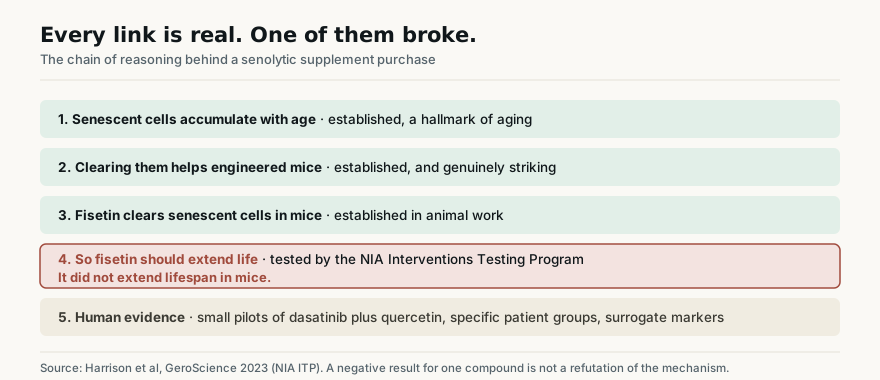
It also does not end the story: the ITP tested one compound, at one dose, on one schedule, for lifespan. Fisetin might still do something useful for a specific condition on a different protocol, and other senescent-cell drugs may behave differently. What cannot survive the result is the confident retail claim that fisetin is a proven anti-aging compound.
Why a single mouse result outweighs the label
The fisetin claims on a typical senolytic supplement trace back to earlier work from one lab. The Interventions Testing Program exists precisely to check claims like that: the same compound, fed to genetically mixed mice at three sites at once, judged against a protocol fixed in advance.
When that design found no significant lifespan gain in males or females, it did not prove fisetin useless. It showed the headline result did not reproduce under the strictest conditions available. For a reader deciding whether to pay for a bottle, that is the most relevant fact on the table.
- What this does not say
- One dose and delivery method in mice; intermittent or higher-dose regimens and human effects are untested by this programme.
Which natural senolytic is the most effective?
By laboratory measurement, fisetin. Comparative work found it produced a greater senolytic effect than other candidates including quercetin.[5] That comparison is real, and it is what put fisetin at the head of the category.
Potency is not benefit
What it measures is potency in a controlled system, not benefit in a person. Being the best of a group of compounds none of which has demonstrated a human outcome is a genuine distinction with a limited practical meaning, and the marketing routinely reports the first half.
The quercetin problem
Quercetin appears on senolytic labels constantly, and its senolytic evidence is almost entirely as half of a pair. The compound studied in human senolytic research is dasatinib plus quercetin, where dasatinib is a prescription tyrosine kinase inhibitor used in leukemia treatment.
What a quercetin capsule is missing
A quercetin capsule contains no dasatinib, so selling it under the senolytic banner borrows credibility from trials of a different intervention, invisible on the packaging. Quercetin does have its own separate evidence base, largely around antioxidant and anti-inflammatory effects, which is worth considering on its own terms rather than dressed up as something else.[6]
What the human trials actually showed
Small, short and specific: a pilot study of dasatinib plus quercetin in patients with diabetic kidney disease reported reductions in senescent cell markers in adipose tissue and skin, in a handful of participants after a few days of dosing.[7] It was a feasibility study showing the approach does something measurable in people, a legitimate first step.
Clock and immune-cell follow-ups
Later work has looked at whether senolytic treatment shifts DNA methylation clocks and immune cell populations.[8] In that uncontrolled 19-person pilot, first-generation clocks showed faster age acceleration after 6 months and telomere length fell, while newer clocks showed no difference.
Clock choice changed the conclusion, which is the recurring problem with biological age tests as a trial endpoint. Again the right question, again a surrogate measure. Nobody has run an adequately powered randomized trial with a functional endpoint in ordinary older adults, and until somebody does, this category has a mechanism and a hypothesis rather than a treatment.
The fisetin protocol people copy
The pattern circulating online is high-dose intermittent: a large dose for two or three consecutive days, repeated monthly, on the reasoning that senescent cells need clearing periodically rather than continuously. The logic comes from the animal work and it is internally coherent.
Why the protocol is unvalidated
It has never been validated in a randomized human trial. Mouse doses do not scale to people by simple multiplication, they sit far above anything food provides, and nobody knows what repeated exposure does over years. Our guide to where the senolytic dose numbers came from traces each figure back to its source, which is a clarifying exercise.
How to flush out senescent cells naturally
The honest answer is that no dietary or supplement approach has been shown to do this in humans. The intervention with the best supporting evidence for reducing markers of senescence is exercise, which is a genuinely unsatisfying answer to anyone who came looking for a capsule.
Fisetin in food
Food quantities of fisetin are far below the doses used in senolytic research. Strawberries are the richest common source, followed by apples, persimmons, onions and grapes. Eating them is good for other reasons and is not a senolytic protocol.
You'd have to eat 15 pounds of strawberries in five minutes to get the kind of dose we're giving.
How much fisetin should I take?
There is no established human dose, because there is no human outcome trial from which to derive one. Every number on every label is either extrapolated from animal work or copied from another label. Blends compound the problem by quoting multi-gram totals across several ingredients, so you cannot tell how much of anything you are taking.
What a label must tell you
If you are going to take it anyway, the minimum standard is knowing the milligrams of the named compound and being able to work out cost per gram. Fisetin and quercetin are cheap raw materials, so a premium price in this category usually reflects packaging rather than substance.
Who should not take fisetin?
Skip it if you are pregnant or breastfeeding, or have an active cancer diagnosis without oncology input, which matters because senescence biology interacts with tumor suppression in complicated ways. Anyone on anticoagulants or with a bleeding risk, since flavonoids at high doses can affect platelet function. And anyone on prescription medication who has not checked for interactions.
The high-dose protocol warning
The high-dose intermittent protocols deserve a separate warning. They were designed for supervised research settings and their safety in unsupervised repeated use has not been established. This is the clearest case in the whole supplement field for talking to a clinician first.
What would change the picture
An adequately powered randomized trial in ordinary older adults, with a functional endpoint rather than a marker, reported in full including the endpoints that did not move. Several groups are working toward exactly that, which is why this remains an area worth following.
Until one reports, the responsible position is that senolytics are the most interesting unproven idea in the field. If you want to see where they sit against everything else, our guide to where every longevity supplement ranks puts them on the ladder alongside compounds with stronger and weaker cases.
The bottom line
The senolytic idea is excellent and the senolytic product market is running far ahead of it. Senescent cells are real, they matter, and clearing them helps in animals.
Yet the specific compound sold to do that failed the field's most rigorous lifespan test, the other compound on the label borrows its evidence from a prescription drug it does not contain, and the human data is a handful of short pilots. Follow this one. Do not confuse following it with treating yourself.
Frequently asked questions
Which natural senolytic is the most effective?
In laboratory comparisons fisetin has shown a greater senolytic effect than quercetin, which is why it became the flagship of the category. Effective in a dish and effective in a person are different claims, and the compound has not cleared the second one.
Did fisetin extend lifespan in the big mouse study?
No. The NIA Interventions Testing Program, the most rigorous multi-site mouse lifespan program in the field, tested fisetin and reported no lifespan extension. That result is the single most important fact about this category and almost nobody selling these compounds mentions it.
So are senolytics a dead end?
Not necessarily: the mechanism is real, senescent cells accumulate with age, and clearing them in genetically engineered mice produced striking results. What failed was one specific compound at one specific dose in one specific program. That is a serious negative signal for fisetin, not a refutation of senescent-cell clearance as a concept.
What is the difference between fisetin and quercetin?
Both are flavonoids found in food. Fisetin has the stronger stand-alone senolytic signal in animal work. Quercetin's senolytic evidence is mostly as half of a combination with dasatinib, a prescription cancer drug, which is a very different product from a quercetin capsule.
Is quercetin on its own a senolytic?
The human senolytic research on quercetin used it combined with dasatinib, a prescription drug. Taking quercetin alone and calling it senolytic borrows credibility from trials that tested something else. Quercetin has its own separate evidence base as an antioxidant and anti-inflammatory.
What did the human senolytic trials actually show?
Small pilot studies of dasatinib plus quercetin have reported reductions in senescent cell markers in specific tissues, in specific patient groups, over short periods. They were designed to establish feasibility, not benefit, and they involved a prescription chemotherapy drug under supervision.
How to flush out senescent cells naturally?
There is no demonstrated way to do this with diet or supplements in humans. Exercise is the intervention with the best supporting evidence for reducing markers of senescence, which is unsatisfying to anyone hoping for a capsule and is what the data supports.
What is the fisetin senolytic protocol people follow?
The common self-administered pattern is high-dose intermittent, typically two or three consecutive days at a high dose repeated monthly, copied from animal studies. It has never been validated in a randomized human trial, and the dose translation from mice is not straightforward.
How much fisetin is in food?
Strawberries are the richest common source, with apples, persimmons, onions and grapes contributing smaller amounts. Food quantities are far below the doses used in animal senolytic work, which is why the protocols use isolated high-dose supplements.
Who should not take fisetin?
Anyone pregnant or breastfeeding, anyone with an active cancer diagnosis without oncology input, anyone on anticoagulants or with a bleeding risk, and anyone on prescription medication who has not checked interactions. High-dose intermittent protocols in particular should not be self-administered without clinical oversight.
Does fisetin have side effects?
At ordinary supplement doses it appears well tolerated in short use. The high-dose intermittent protocols are where the uncertainty lives, because they were not designed for unsupervised use and their safety in people has not been characterized over time.
Is it worth taking fisetin and quercetin together?
No trial has tested that combination in humans on any outcome. Products sell it because both names carry senolytic associations. Combining two compounds with thin evidence produces a product with thin evidence, not a stronger one.
Do senolytics reverse epigenetic age?
One study assessed dasatinib plus quercetin against DNA methylation clocks and immune cell subsets, which is exactly the right question to ask. Epigenetic clocks are surrogate measures, so a change in one is a lead to follow rather than a demonstrated benefit.
How much fisetin should I take?
There is no established human dose because there is no human outcome trial to derive one from. Products offer a very wide range and some blends advertise multi-gram totals across several ingredients. Any number you see is extrapolated from animal work or copied from another label.
Why do senolytic products cost so much?
Some do and some do not. Fisetin and quercetin are inexpensive raw materials, so a high price usually reflects blending, branding and dose escalation rather than an expensive ingredient. This is a category where working out cost per gram is unusually revealing.
Are senolytics FDA approved?
No. Fisetin and quercetin are dietary supplements, not evaluated by the FDA for efficacy. Dasatinib is an approved prescription cancer drug, approved for cancer and not for aging, and its use in senolytic research is off-label and supervised.
What should I look for on a senolytic label?
The named compound and its milligrams, not a blend total, and whether the product is quoting evidence from dasatinib combination studies while containing no dasatinib. A certificate of analysis. And a cost per gram you calculated yourself.
What would change the picture for senolytics?
A randomized human trial with a functional endpoint, adequately powered, in ordinary older adults rather than a specific patient group. Several groups are working toward that. Until one reports, this remains an area to follow rather than a treatment to buy.
References
8 sources, all link-checked; oldest check
- Astaxanthin and meclizine extend lifespan in UM-HET3 male mice; fisetin, SG1002, dimethyl fumarate and mycophenolic acid do not. Harrison DE et al. GeroScience 2023 (NIA Interventions Testing Program; cited 64).The most rigorous multi-site mouse lifespan program tested fisetin and found no lifespan extension.Verified Sep 15, 2026
- Fisetin as a senotherapeutic agent: evidence and perspectives. Tavenier J et al. 2024 (cited 96).Review; notes fisetin showed a greater senolytic effect than other candidates including quercetin in murine embryonic fibroblasts.Publisher blocks automated checks · last tried Sep 15, 2026
- Exploring the effects of dasatinib, quercetin and fisetin on DNA methylation clocks. Lee E et al. 2024 (cited 61).Assessed dasatinib plus quercetin senolytic treatment against DNA methylation, epigenetic age and immune cell subsets.Verified Sep 15, 2026
- Fisetin is a senotherapeutic that extends health and lifespan. Yousefzadeh MJ et al. EBioMedicine 2018;36:18–28.Publisher blocks automated checks · last tried Sep 15, 2026
- Senolytics improve physical function and increase lifespan in old age. Xu M et al. Nature Medicine 2018;24:1246–1256.Verified Sep 15, 2026
- Senolytics decrease senescent cells in humans: preliminary report from a clinical trial of dasatinib plus quercetin. Hickson LJ et al. EBioMedicine 2019;47:446–456.Small first-in-human senolytic trial.Publisher blocks automated checks · last tried Sep 15, 2026
- Quercetin: evidence summary. Examine.com.Publisher blocks automated checks · last tried Sep 15, 2026
- Hallmarks of aging: an expanding universe. López-Otín C et al. Cell 2023;186(2):243–278.Updated framework: twelve hallmarks.Publisher blocks automated checks · last tried Sep 15, 2026
Every link above is re-requested on a schedule by an automated checker; the date shown is when it last answered. Publishers that block automated requests are marked as such rather than reported broken. Our editorial standards explain how a source gets cited here in the first place.
Filed by the Rapamycin.store evidence desk. Each source is re-checked when the page is reviewed.
Own a longevity or health brand?
Rapamycin.store publishes sponsored and guest posts on an aged, topically-relevant domain, and offers display advertising. Tell us what you want to promote and we'll send our current options.