The evidence guide
Spermidine supplements: the problem at the center of the category
A spermidine supplement is sold as a fasting mimic, yet a placebo-controlled trial giving 15 mg a day in two 5-day phases (Senekowitsch 2023) did not raise plasma spermidine at all.

The short version
Most spermidine marketing skips a 2023 placebo-controlled study run over two 5-day phases. Its title says that high-dose spermidine supplementation does not increase spermidine levels in blood plasma and saliva, and the retail listings, brand pages and affiliate roundups rarely mention it.
That is not a minor caveat. It is the central claim of the category being tested and coming back negative. This page is built around it, because a reader deciding whether to spend money here deserves to see the study the product pages leave out.
| Product | Evidence | Typical dose | 3rd-party tested | Best for | Not for | Price band |
|---|---|---|---|---|---|---|
| Wheat germ extract | Limited evidence | typically 1 to 3 mg spermidine per serving | Not stated | the form closest to the dietary intake evidence | anyone avoiding gluten, or chasing milligram totals | $ · budget |
| Spermidine trihydrochloride (fermentation) | Limited evidence | 10 to 15 mg per serving on sale | Not stated | high stated milligrams and no wheat allergens | anyone assuming higher milligrams means higher plasma levels | $$ · mid |
| Rice germ extract | Limited evidence | around 3 mg per serving | Not stated | a wheat-free botanical source | a trial-supported advantage over other sources | $$ · mid |
| Dietary spermidine from food | Early / mixed evidence | varies with diet | Not stated | the route the observational mortality data was measured on | anyone wanting a precise dose | $ · budget |
Affiliate links. We may earn a commission; it does not change our assessments.
What a spermidine supplement actually contains
Spermidine is a polyamine, a small molecule present in every living cell and involved in a wide range of basic cellular functions. Tissue levels decline with age, which is the observation the entire supplement category is built on. It appears in food, most abundantly in wheat germ, and it is also produced by gut bacteria.
Why longevity researchers care
Its interest to longevity research comes from autophagy, the way cells break down and recycle their own damaged parts.[1]
Impaired autophagy is one of the recognized hallmarks of aging, and spermidine is among the best-characterized dietary inducers of it in laboratory systems.[2] Urolithin A is sold on the mitochondrial branch of the same recycling system, reviewed in our urolithin A guide.
The absorption problem at the center of the category
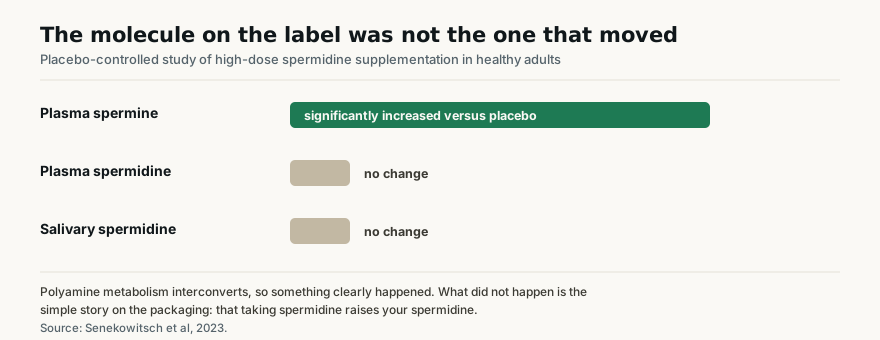
A placebo-controlled study of high-dose spermidine supplementation in healthy adults measured what happened to polyamine levels: compared with placebo, supplementation significantly increased spermine in plasma, but it did not increase spermidine in plasma or in saliva.[3]
How the crossover study was run
Show the numbers as a table
| When | Event | Detail |
|---|---|---|
| Phase 1 | 5-day intervention | 15 mg/day or placebo |
| Washout | 9 days off | no supplement |
| Phase 2 | 5-day crossover | arms switched |
| Result | Spermine rose | plasma spermidine did not |
Limited evidence Read that against the marketing: products promise that taking spermidine restores a level that declines with age, and the one study that checked found the level did not move.
Something is happening, since spermine rose and polyamines interconvert in complicated ways. But the simple story on the label is not what was measured.
What that result does and does not prove
This does not prove the compound is useless. It does mean anyone selling you a milligram number owes you an explanation of what that number achieves, and none of the products on page one offers one.
What does spermidine supplement do for you?
The claims made for it are autophagy induction, cognitive support in older adults, cardiovascular benefit and reduced inflammation. The strength behind those claims varies enormously and the marketing flattens the differences.
Where each claim actually stands
- Autophagy induction is well supported in cells and in animals, and is the reason the compound is studied at all.
- Cardiovascular and inflammation findings come largely from animal work, including the mouse cardioprotection and lifespan data that put spermidine on the map.[4] Human cognitive studies exist and are small and early.[5]
None of this is nothing, but none of it is a demonstrated benefit in people from a capsule.
What the human data actually is
The finding that made this field pay attention was observational. In a population cohort, higher dietary spermidine intake was associated with lower all-cause mortality.[6] The association was substantial enough to be striking and it was measured on food, in people who were also eating everything else that comes with a wheat germ and legume rich diet.
Why a food association is not a capsule result
Observational nutrition data of this kind is genuinely useful for generating hypotheses and genuinely unreliable for establishing causes. Wheat germ and pulse eaters differ from everyone else in ways nobody measured. Converting that association into a capsule is a leap the data does not license, and it is the leap the whole product category is built on.
Show the numbers as a table
| Measure | Value |
|---|---|
| Lowest intake third | 40.5 |
| Middle intake third | 23.7 |
| Highest intake third | 15.1 |
What food is highest in spermidine?
Wheat germ, by a wide margin, which is why it is the extraction source for most products. After that: aged cheeses, soybeans and fermented soy products such as natto, mushrooms, peas and other legumes.
Why food is the more faithful route
This is the route with human association data attached to it, and it is also the cheapest. If the observational finding is the reason you are interested in spermidine, then eating the foods it was measured in is a more faithful reproduction of the evidence than any capsule.
What is the best form of spermidine supplement?
Two families. Wheat germ extract delivers roughly 1 to 3 mg of spermidine per serving inside a food matrix, and is the closest thing to the dietary evidence. Spermidine trihydrochloride, made by fermentation, delivers 10 mg or more of the isolated molecule and contains no wheat.
Potency claims versus benefit claims
Manufacturers of the pure form advertise being many times more potent than wheat germ extracts. That is true as a milligram statement and unproven as a benefit statement, and the pharmacokinetic result above is precisely the reason to keep those two apart. No trial has compared the forms on any outcome.
How much spermidine should I take?
Human research has mostly used somewhere around 1.2 mg to 6 mg a day. Products on sale reach 10 mg and 15 mg per serving, and advertise the higher figure as an advantage.
Why bigger milligram numbers are not the answer
Given that a high-dose study failed to raise plasma spermidine, chasing large milligram numbers looks like paying more for an unmeasured difference. If you want the dosing detail and where each number came from, see our guide to what the spermidine studies actually dosed.
Does spermidine really mimic fasting?
Fasting mimetic is a mechanistic label. It means the compound is proposed to trigger some of the same cellular machinery that fasting triggers, principally autophagy. It does not mean that taking a capsule reproduces what fasting does to a person.
What the fasting label leaves out
Nobody has demonstrated that equivalence in humans, and the metabolic effects of fasting extend far beyond autophagy. Anyone selling a pill as a substitute for a behavior is making a claim considerably larger than the mechanism supports. We look at the underlying process in our guide to what autophagy actually is and what triggers it.
Is it okay to take spermidine every day?
Daily use at the doses on sale has not produced safety signals in the short human studies available. The plasma study ran two 5-day phases in 12 volunteers, so this is an absence of reported problems, not proof of long-term safety.[3]
Who should avoid spermidine?
Anyone pregnant or breastfeeding, anyone with an active cancer diagnosis without oncology input, and anyone on prescription medication who has not checked for interactions. The cancer caution deserves emphasis rather than boilerplate treatment: autophagy modulation is a plausible mechanism with genuinely context-dependent effects, and this is not a decision to make from a supplement label.
The gluten question
Wheat germ products also carry a gluten consideration for anyone who avoids it. The fermentation-derived trihydrochloride does not.
Is spermidine worth the money?
A spermidine supplement is cheap relative to the rest of the category, and that is its saving grace. That genuinely changes the calculation: a low-cost bet on an unproven compound is a different proposition from a high-cost one, and this is one of the low-cost ones.
Where it sits in a limited budget
What it should not do is displace something better evidenced from a limited budget. Set against the compounds with randomized human outcome data, spermidine sits at the bottom of the evidence ladder we use in our guide to ranking longevity supplements by evidence.
How to read a spermidine label without being sold to
- Milligrams of spermidine, not of extract. These differ by a factor of a hundred or more, and the larger number is the one on the front.
- The source. Wheat germ, rice germ or fermentation-derived trihydrochloride, each with different implications.
- Serving size in capsules. So the milligram figure can be compared with the research range.
- A certificate of analysis. Ask for it, as with anything in this market.
- What the claim rests on. Autophagy language describes a mechanism observed in cells, not an outcome measured in you.
Spermidine is a real molecule doing real things in cells, attached to one of the more interesting observational findings in nutrition and aging, sold in a form that a controlled study suggests may not raise the level it claims to raise. That makes it worth watching scientifically and hard to defend at any price above trivial.
Eat the wheat germ, and watch the trials.
Frequently asked questions
If a supplement does not raise blood spermidine, what am I paying for?
It is an unproven bet: in a placebo-controlled study of high-dose supplementation in healthy adults, plasma spermine rose but spermidine in plasma and saliva did not. Any benefit would have to come through that spermine rise or another route, and no human outcome trial has shown one. The product is at least cheap.
Does spermidine supplementation actually raise spermidine levels?
A placebo-controlled study of high-dose supplementation found that it did not. Spermine in plasma rose significantly; spermidine in plasma and saliva did not. That is a serious problem for a category whose entire premise is topping up a molecule that declines with age, and it sits at the top of the search results being ignored.
Should I just eat wheat germ instead of taking a capsule?
Wheat germ is the richest food source and the raw material for most extracts, followed by aged cheese, soy foods such as natto, mushrooms and legumes. The dietary evidence was built on food, so eating it is the route closest to that evidence. Neither food nor capsule has a trial showing longer life.
Is it okay to take spermidine every day?
Daily use at the doses on sale has not produced safety signals in the short human studies available. Those studies were small and brief, so this is a statement about the absence of reported problems rather than a demonstration of long-term safety.
Can you take too much spermidine?
The upper end has not been well characterized in humans, which is itself the answer. Products range from about 1 mg to 15 mg per serving, and the higher end goes well beyond anything the human research used. Higher is not demonstrably better here, and one study found high doses did not even move the target molecule.
Does spermidine help you lose weight?
There is no human trial evidence for weight loss. The connection people make comes from autophagy being associated with fasting, and fasting being associated with weight loss. That is an association between two associations, which is not a finding.
How much spermidine should I take?
Human research has mostly used roughly 1.2 mg to 6 mg a day. Commercial products go to 10 mg and beyond. Since the pharmacokinetic study found high doses failing to raise plasma spermidine at all, the case for chasing large milligram numbers is weak.
What is the evidence that spermidine helps people live longer?
An observational cohort found that higher dietary spermidine intake was associated with lower all-cause mortality. That is a food-intake association in a population, with all the confounding that implies, and it is not the same as showing that a capsule extends life.
Does spermidine really mimic fasting?
Fasting mimetic is a mechanistic description, not a demonstrated equivalence. Both are proposed to induce autophagy. Nobody has shown that a spermidine capsule reproduces the metabolic effects of fasting in a person, and the marketing frequently implies otherwise.
Is the expensive pure form actually better than wheat germ extract?
It is closer to the form the dietary evidence was built on, and it contains far fewer milligrams. Pure trihydrochloride delivers the higher number and is wheat-free, which matters for gluten avoidance. Neither has been shown superior on an outcome because the comparison has not been run.
Does spermidine help hair growth?
Hair claims appear on packaging and are not supported by randomized human trials. Some early laboratory work on hair follicles exists, which is a reason for someone to run a study rather than a reason for a label to make the claim.
Are there side effects?
The short human studies have not reported meaningful adverse effects at the doses used. Wheat germ products carry a gluten consideration. The main practical cost is financial and the main risk is paying for a molecule that may not reach your plasma.
Who should avoid spermidine?
Anyone pregnant or breastfeeding, anyone with an active cancer diagnosis without oncology input, and anyone on prescription medication who has not checked interactions. Autophagy modulation is a plausible enough mechanism that the cancer caution is more than boilerplate.
Is spermidine worth the money?
It is one of the cheaper compounds in the category, which softens the question. It also has the weakest human evidence of the mainstream longevity supplements, and a pharmacokinetic result suggesting the capsules may not do the one thing they claim. Cheap and unproven is a better deal than expensive and unproven, but it is still unproven.
What should I look for on a spermidine label?
Milligrams of spermidine, not milligrams of wheat germ extract, since those numbers differ by a factor of a hundred or more. Then the source, the serving size in capsules, a certificate of analysis, and a cost per day you worked out yourself.
How would I test whether it is doing anything for me?
Honestly, with difficulty, because there is no accessible readout for autophagy and the plasma marker may not move. That is a reason to be sceptical of any personal test you design here, and a reason to spend the money elsewhere if your budget only stretches to one compound.
References
6 sources, all link-checked; oldest check
- High-dose spermidine supplementation does not increase spermidine levels in blood plasma and saliva of healthy adults. Senekowitsch S et al. 2023 (cited 52).Placebo-controlled: supplementation significantly raised plasma spermine but did not raise spermidine in plasma or saliva.Verified Sep 15, 2026
- Higher spermidine intake is linked to lower mortality: a prospective population-based study. Kiechl S et al. American Journal of Clinical Nutrition 2018;108(2):371–380.Observational (Bruneck cohort): association, not proof of causation.Verified Sep 15, 2026
- Cardioprotection and lifespan extension by the natural polyamine spermidine. Eisenberg T et al. Nature Medicine 2016;22:1428–1438.Verified Sep 15, 2026
- New insights into the roles and mechanisms of spermidine in aging and age-related diseases. Review, PMC 2021.Mechanistic review covering autophagy induction and the inflammation findings attributed to Eisenberg and colleagues.Verified Sep 15, 2026
- Hallmarks of aging: an expanding universe. López-Otín C et al. Cell 2023;186(2):243–278.Updated framework: twelve hallmarks.Publisher blocks automated checks · last tried Sep 15, 2026
- Autophagy fights disease through cellular self-digestion. Mizushima N et al. Nature 2008;451:1069–1075.Verified Sep 15, 2026
Every link above is re-requested on a schedule by an automated checker; the date shown is when it last answered. Publishers that block automated requests are marked as such rather than reported broken. Our editorial standards explain how a source gets cited here in the first place.
Filed by the Rapamycin.store evidence desk. Each source is re-checked when the page is reviewed.
Own a longevity or health brand?
Rapamycin.store publishes sponsored and guest posts on an aged, topically-relevant domain, and offers display advertising. Tell us what you want to promote and we'll send our current options.